The cable is the part of an automatic platform guardrail that passengers actually see, and it is the element that physically stops a fall or absorbs a stumble toward the track. While the electromechanical drive handles the rise and fall, the cable material defines how the barrier feels on contact, how it buffers an impact, how it behaves in a fire, and how it survives a decade of weather. UPARK now offers three cable materials for its automatic platform guardrail systems - 304 stainless steel wire rope, high-strength nylon rope, and aramid (flame-retardant) rope - so operators can match the barrier to a station's safety, climate, and budget profile rather than accepting a one-size-fits-all solution. This three-option framework, introduced with the latest high-speed-rail platform scheme, turns cable selection into a deliberate engineering decision instead of a fixed default.
Why the Cable Material Decides Real-World Performance
A platform-edge barrier cycles dozens of times per day and must stay intact on impact, resist corrosion, and remain visible in poor light. The cable is the interface between the system and the passenger. Its tensile strength sets the protection level; its flexibility sets the buffering behavior on contact; and its material sets how it ages under ultraviolet light, salt spray, and temperature swing. Choosing the right cable is therefore not a cosmetic decision - it is a safety and lifecycle decision that affects maintenance cost, fire compliance, and the passenger's everyday experience of the platform.
Option 1 - 304 Stainless Steel Wire Rope
The steel wire rope uses 304 stainless steel strands protected by an outer plastic coating and a 6 cm high-density sponge sheath that prevents surface scratching and adds a clear visual warning band. Each cable is 4 to 5 mm in diameter, arranged in six vertical levels across the barrier face, and rated above 10 kN (roughly 1,020 kgf) of break strength. Its core advantages are high strength, a rigid structure, and excellent corrosion resistance, making it the mature, general-purpose choice suitable for the majority of overseas projects and retrofit installations. Where a station needs maximum physical presence and long-term dimensional stability, 304 stainless steel wire rope remains the dependable default, and its metallic appearance reads clearly as a hard safety edge to waiting passengers.
Option 2 - High-Strength Nylon Rope
The nylon option uses a synthetic fiber rope, typically a single 3 mm strand with multiple strands twisted together, delivering 35 to 40 kg per strand and roughly 175 to 200 kg across a five-strand group. Its defining trait is flexibility: with 15 to 30 percent elongation, the rope provides superior elastic buffering when contacted, which reduces the shock transmitted to a passenger who stumbles against it. Individual strands can be replaced without re-roping the whole barrier, keeping intervention cost low, and the material is cost-friendly, making it attractive for light rail, tram, and upgrade projects where soft buffering and minimal maintenance effort matter more than maximum rigidity. With no oil line or pneumatic element in the drive, a nylon-roped barrier keeps the same maintenance-free electromechanical simplicity as its steel counterpart.
Option 3 - Aramid Flame-Retardant Rope (High-Speed Rail Default)
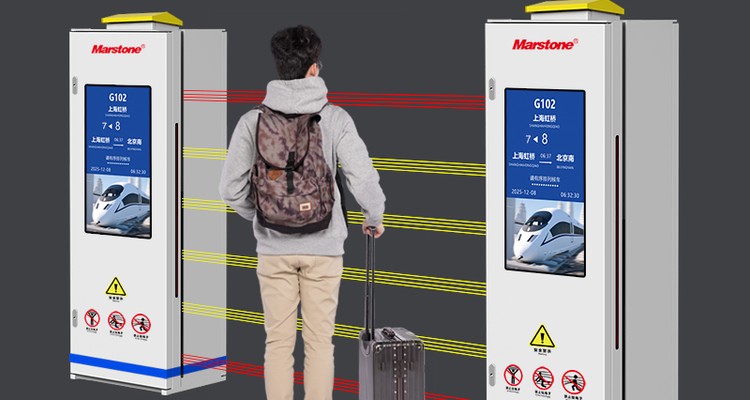
Aramid rope is the material showcased as the default in the latest domestic high-speed-rail platform scheme. It uses a 3 mm aramid (flame-retardant) rope with a yellow aramid braided core for high-visibility warning. The layout is six vertical groups, each with four ropes side by side (24 ropes in total), rated at 15,000 N or more (about 1,530 kgf) of break strength with 5 percent or less elongation. Critically, aramid is self-extinguishing: under flame it carbonizes rather than melting or dripping, providing genuine fire safety for enclosed and high-occupancy stations and meeting the GB 24543-2009 mechanical basis with uniform tension adjustment via tensioner and tension meter. It resists corrosion and weathering and operates from -40 C upward, suiting the most demanding climate and fire-safety scenarios such as national railways and high-speed lines.
Side-by-Side: What Each Cable Brings
Steel wire rope leads on rigidity and universal corrosion resistance at moderate cost. Nylon leads on flexibility, elastic buffering, and lowest intervention cost, with the added benefit of per-strand replacement. Aramid leads on fire safety, tensile strength, dimensional stability, and all-climate endurance, and its yellow braided core gives the strongest visual cue at the platform edge. Steel and nylon are proven, familiar choices; aramid is the forward-looking choice where fire certification and extreme environment are mandatory. All three mount on the same electromechanical, 36V low-voltage drive, so the operator's decision is purely about the cable character - not about re-engineering the barrier mechanism.
Matching Cable to Station Scenario
For national railways and high-speed lines with strict fire and safety codes, aramid is the recommended default. For metro and urban rail where a strong, stable, corrosion-resistant barrier is needed at sensible cost, 304 stainless steel wire rope is the workhorse. For light rail, tram, and retrofit projects that prioritize soft buffering and easy single-strand maintenance, nylon rope is the pragmatic pick. Outdoor and coastal stations benefit from the corrosion resistance of steel or the all-climate endurance of aramid; cold-region lines should note aramid's -40 C starting point alongside steel's proven low-temperature behavior. The selection is rarely exclusive - a network can standardize on one cable while specifying another for an unusually harsh or fire-sensitive location.
How Cable Choice Fits the Drive System
It is worth separating the cable from the drive. UPARK's barrier uses a sealed electromechanical drive on 36V DC - there is no oil to thicken in the cold and no pneumatic line to freeze, both common failure modes for fluid-dependent barriers in outdoor rail environments. The cable material does not change the drive; it changes what the passenger encounters and what the barrier withstands. This modularity means a single platform can be specified with steel, nylon, or aramid cables without altering the civil works, control logic, or signaling integration already designed for the station, which keeps procurement and installation straightforward across a mixed fleet of sites.
Compliance and Lifecycle
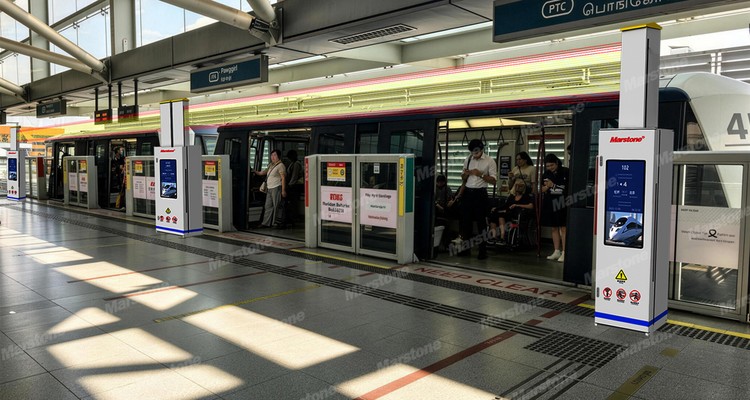
Every configuration is built on the same EN 13231-3 tested, 36V low-voltage architecture, with impact resistance rated to 300 kg and industrial motors validated for over 250,000 cycles. Standby draw stays below 10 W per unit, and dual emergency release - gravity descent on power loss plus a mechanical manual rope - opens the barrier within five seconds in any weather. The cable choice therefore affects aesthetics, buffering, fire safety, and climate range, not the underlying safety certification of the system. For a live urban example of cable-type barriers in service, the Singapore LRT platform safety case study shows how retractable cable barriers were deployed in a dense transit environment.
To choose the right cable for your platform guardrail deployment, review our rope vs board vs cable barrier selection guide or visit the automatic platform guardrail product page. For a station-specific recommendation covering climate, fire code, and duty cycle, contact UPARK.
call us :
+86 18206096507 e-mail : [email protected]




 ipv6 network supported