The bollard itself is only half the system. The accessories — lights, reflectors, controls, and sensors — determine how well the installation works in daily use. A bollard without LED warning lights is a trip hazard at night. A bollard without a loop detector stays up when an authorized car is sitting on top of it. GS Automatic lists these accessories on their product page for good reason. They are not optional. They are the difference between a bollard that works on paper and one that works in real life.
LED warning lights
Every automatic bollard should have LED lights integrated into the top ring or cylinder body. The light serves two purposes: it makes the bollard visible to drivers at night, and it signals the bollard's status — typically red when raised (do not approach), green when lowered (safe to pass), and flashing during movement (stand clear).
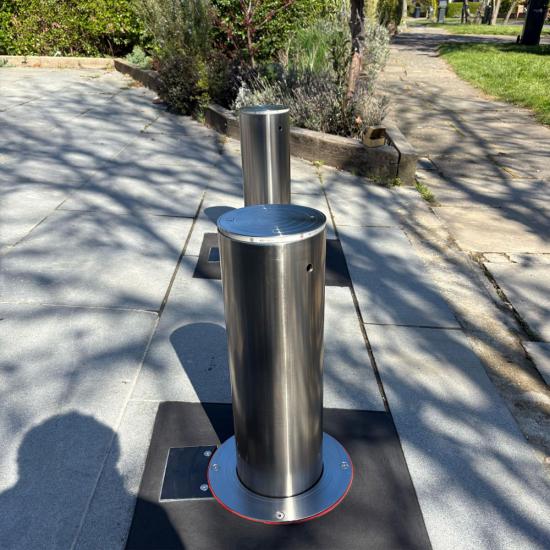
GS Automatic includes integrated LED lights as standard on the GS600. The LED ring sits at the top of the cylinder and is visible from 360 degrees. When selecting LED lights, check the brightness spec — lumens, not just "has LEDs." In direct sunlight, a weak LED ring is invisible. Look for high-output LEDs rated for outdoor use, with a minimum of 100 lumens per bollard. Also check the LED lifespan rating: 50,000 hours minimum, which translates to roughly 11 years at 12 hours of operation per day.
Reflective strips and visibility
GS specifies "3M brand" reflective adhesive strips as an option on the GS600, with customizable colors and logo printing. Naming the brand — 3M — is a smart trust signal. 3M reflective materials are an industry standard for traffic and safety applications, with known performance characteristics. A generic "reflective strip" could be anything from automotive-grade retroreflective tape to decorative foil that barely reflects.
Reflective strips matter because LED lights can fail. A power outage kills the LEDs. A reflective strip still works as long as there is a vehicle headlight or streetlight pointed at it. For emergency preparedness, reflective strips are not optional — they are the backup visibility system. The strip should wrap around the full circumference of the cylinder at a height visible to both passenger cars and trucks — typically 500 to 700 mm above ground.
PLC control cabinets
The control cabinet is the brain of the bollard system. GS describes theirs as a "fully integrated PLC control cabinet" that connects to RFID readers, license plate recognition (LPR) cameras, traffic lights, inductive loop detectors, and central security management platforms. A PLC (programmable logic controller) is an industrial-grade control computer designed for 24/7 operation in harsh environments. It is more reliable than a consumer-grade microcontroller and can be programmed for complex access logic: raise bollard A before lowering bollard B to create a vehicle trap, coordinate bollard timing with a traffic light, or integrate with a building management system.
When evaluating control cabinets, ask about: programming flexibility (can you customize the access logic without calling the manufacturer?), communication protocols (does it support Modbus, TCP/IP, dry contact relays?), and remote access (can you monitor and control the bollards from a central station or mobile device?). A control cabinet that only supports a basic remote control is fine for a single residential driveway. It is not enough for a multi-lane facility with integrated security systems.
Access control integration
Bollards do not operate in isolation. They connect to:
RFID readers: Long-range UHF RFID tags on vehicle windshields trigger bollard lowering automatically as the vehicle approaches. Range is typically 3 to 10 meters. Useful for employee parking, resident access, and fleet vehicle entry where the driver should not need to stop and use a keypad.
License plate recognition (LPR): ANPR cameras read license plates and check against a whitelist database. White-listed vehicles trigger bollard lowering. All others are denied. LPR is more secure than RFID (plates are harder to clone than RFID tags) but more expensive and requires good lighting and camera positioning.
Inductive loop detectors: A wire loop buried in the pavement detects the metal mass of a vehicle. This serves two purposes: safety (do not raise the bollard while a vehicle is on top of it) and exit detection (automatically lower the bollard when a vehicle approaches from the exit side). Loop detectors are simple, reliable, and unaffected by weather. Every automatic bollard installation with bidirectional traffic should have them.
Traffic lights: Bollards integrated with a traffic light system show red when raised and green when lowered. This is standard at multi-lane checkpoints and high-traffic entrances where drivers need a clear visual signal from a distance.
Customization: finish, color, and branding
GS offers customizable options for cylinder height, finish color, logo engraving, and a heating unit for cold climates. These are not cosmetic extras — they affect functionality:
Finish color: Standard brushed stainless steel blends into modern architecture. Powder coating in custom colors (black, dark gray, corporate colors) helps the bollards match building aesthetics or provide higher contrast for visibility. If the bollards are in front of a luxury hotel, architectural integration matters.
Logo engraving: A city seal or corporate logo engraved on the bollard cylinder turns a security device into a branding element. GS offers this as standard. It helps with public acceptance — a bollard with the city logo looks like civic infrastructure, not a military checkpoint.
Heating unit: In regions where winter temperatures drop below -15C, hydraulic fluid thickens and electromechanical grease stiffens. A heating element in the bollard housing keeps the mechanism operational. GS mentions this as an option. If your site is in northern China, Canada, Scandinavia, or Russia, the heating unit is not optional.
Ordering checklist
When ordering bollards, specify these accessories up front. Retrofitting them after installation costs more and may require additional trenching or control cabinet modifications. The accessories to specify: LED warning lights (with brightness spec), reflective strips (with brand and color), control cabinet (with PLC and communication protocols), safety loop detectors (one per lane per direction), access control integration (RFID, LPR, or both), and finish customization (color, logo, heating if needed).
The bollard stops the vehicle. The accessories make the system work. Order both together.
Explore UPARK bollard systems and accessories at Automatic Bollards and Parking Barriers. Contact us for customization options at UPARK.
call us :
+86 18206096507 e-mail : [email protected]




 ipv6 network supported