GS Automatic lists "Life Units: 10 years" in their product specifications. It is a bold claim — and exactly the kind of number that helps buyers make decisions. But what does a 10-year lifespan actually mean for a bollard? Which specifications predict real-world durability, and which are just numbers on a datasheet?
The specs that actually predict longevity
Duty rating. GS Automatic describes their hydraulic bollards as "100% Duty Rated" — meaning the bollard can operate continuously without needing rest cycles to cool down. This matters at high-traffic access points. A bollard rated for 30% duty can only operate for 18 minutes out of every hour. Run it harder than that and the motor overheats, seals degrade faster, and the unit fails early. For any site with more than 100 cycles per day, a 100% duty rating is not optional.

Cycle life testing. GS claims "SGS certified durability with over 5,000 continuous operation cycles tested." Five thousand cycles sounds like a lot — until you do the math. At 500 cycles per day, that is 10 days of operation. A 10-year lifespan at 500 cycles per day means 1.8 million cycles. The 5,000-cycle test proves the design works, not that it will last 10 years. Real-world longevity depends on maintenance quality, operating conditions, and component quality far more than a single test cycle count.
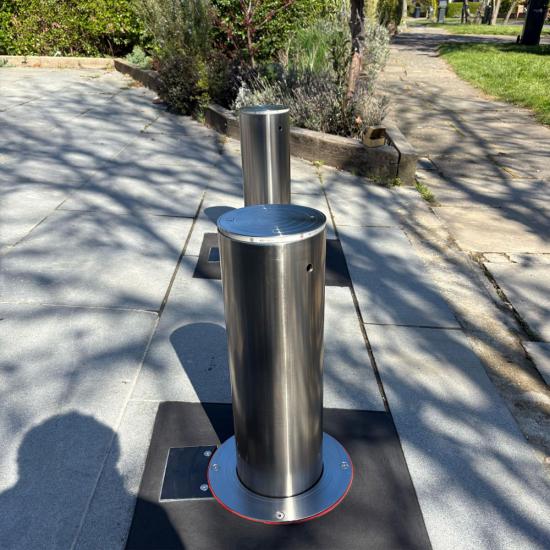
Material grade. GS uses SUS304 stainless steel for the cylinder, with SUS316 as an option. 304 is standard for most outdoor applications. 316 adds molybdenum for better corrosion resistance in marine and chemical environments. If the bollard is within 5 km of a coastline, 316 is worth the upgrade. If not, 304 will last 10+ years with no issues. The grade matters more than the brand — a "stainless steel bollard" without a grade designation could be 201 grade, which will show rust spots within 2 years in outdoor exposure.
Cylinder wall thickness. GS specifies 6 mm wall thickness for the GS600 cylinder. This is not just about crash resistance — it affects dent resistance from everyday use. A delivery truck taps the bollard while backing up. A shopping cart hits it. Road debris kicks up and strikes it. A 6 mm wall will shrug off these impacts. A 3 mm wall will accumulate dents over time, eventually affecting the cylinder's ability to retract smoothly. For commercial and industrial sites, 6 mm is the minimum to target. For high-security sites, 8 to 10 mm is common.
IP rating. IP68 is the gold standard for bollards installed outdoors. The "6" means complete dust protection. The "8" means the unit can be continuously submerged in water beyond 1 meter depth — the exact depth and duration are specified by the manufacturer. GS and UPARK both use IP68. If a bollard is rated IP67 instead of IP68, it means it can survive temporary immersion but not continuous submersion — important in flood-prone areas. IP66 or lower is not adequate for in-ground installation where water accumulates.
Flange and base design. The GS600 has a 400 mm diameter flange that is 38 mm thick. The flange distributes impact forces into the concrete foundation. A thin, narrow flange concentrates stress and can crack the surrounding concrete over time. On a datasheet, the flange dimensions look like minor details. In a 10-year lifecycle, they are the difference between a bollard that stays solidly anchored and one that starts to wobble after the first few vehicle strikes.
What kills bollards early
The things that shorten bollard lifespan are rarely the things manufacturers list in their specifications:
Water ingress is the number one killer. Even IP68 bollards can fail if the cable entry seals are improperly installed during setup. GS's installation guide specifically calls out sealing wires with waterproof tape — a common failure point if the installer is in a hurry. A bollard that spends half its life submerged because the drainage system failed will not last 10 years, regardless of its IP rating.
Undersized foundations crack under repeated impact. A bollard that stops a vehicle at 50 km/h transfers enormous energy into the ground. Do that once and the foundation might hold. Do it a hundred times — or just accumulate vibration from heavy traffic passing nearby — and micro-cracks propagate until the foundation loses integrity. The bollard itself is fine. The foundation is not. The bollard is rated for 10 years. The concrete around it was poured by a contractor who quoted the lowest bid.
Control electronics fail before mechanical components. The cylinder and drive mechanism can last a decade with basic maintenance. The control board, relays, and sensors are more vulnerable — to power surges, lightning strikes, moisture, and insect intrusion. A bollard with a 10-year mechanical warranty but a 1-year electronics warranty tells you where the manufacturer expects failures to happen.
Total cost of ownership over 10 years
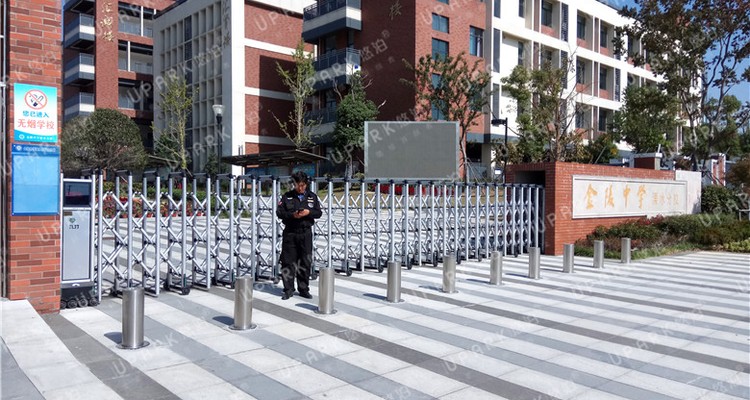
A bollard that costs 30% less to buy but requires a hydraulic fluid change every year, a seal replacement every 3 years, and a pump rebuild at year 7 is not cheaper. It is more expensive — the maintenance costs catch up around year 3 or 4.
The equation changes by drive system. Hydraulic bollards have higher maintenance costs (fluid, filters, seals, hoses) but lower initial cost per unit of lifting force. Electromechanical bollards have lower maintenance costs but may cost more upfront for the same lifting capacity. Over 10 years, the total cost of ownership comparison depends on cycle frequency, operating environment, and local maintenance labor rates.
When comparing products, ask for the recommended maintenance schedule and parts replacement intervals — not just the warranty terms. A 5-year warranty that excludes seals and electronics is less valuable than a 2-year warranty that covers everything. Read the maintenance section of the manual before you buy. If there is no maintenance section, ask why.
Browse durable bollard solutions at Automatic Bollards. For specifications and lifecycle guidance, visit UPARK.
call us :
+86 18206096507 e-mail : [email protected]




 ipv6 network supported