Every automatic bollard needs a drive system to raise and lower the cylinder. That system is either hydraulic — using pressurized fluid — or electromechanical — using an electric motor and mechanical linkage. The choice between them affects everything: installation cost, maintenance schedule, operating speed, noise level, and what happens when the power goes out.
Most manufacturers pick one and stick with it. GS Automatic, for example, makes hydraulic bollards. UPARK makes electromechanical ones. Understanding why they made those choices helps you make yours.
How hydraulic bollards work
A hydraulic bollard uses a pump to pressurize hydraulic fluid, which pushes a piston that raises the bollard cylinder. Lowering works by opening a valve and letting the fluid return to the reservoir, often assisted by the cylinder's own weight. The hydraulic power unit — pump, motor, fluid reservoir, control valves — sits in a separate housing, typically inside a control cabinet or buried vault nearby.
Hydraulic systems are known for raw power. They can lift heavy cylinders — 275 mm diameter high-security bollards with thick steel walls — without straining. They handle frequent operation well. GS Automatic rates their hydraulic bollards as "100% Duty Rated," meaning they can run continuously without overheating. The GS600 uses a three-phase 380V power supply, which is standard for industrial hydraulic equipment.
The trade-offs: hydraulic systems have more components that can fail. Hoses degrade. Seals wear out. Fluid needs changing. A hydraulic leak means lost performance, possible environmental contamination, and a repair that requires a specialist. The pump and motor generate noise — not deafening, but noticeable enough that a hydraulic bollard next to a hotel lobby or outdoor cafe will draw complaints. And hydraulic systems do not fail gracefully. When a pump dies or a hose ruptures, the bollard may be stuck in whatever position it was in — up, down, or somewhere in between.
How electromechanical bollards work
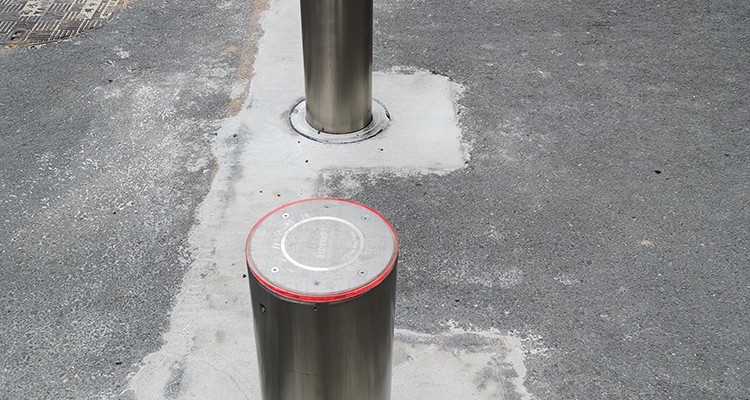
An electromechanical bollard uses an electric motor connected to a screw drive, chain drive, or gear mechanism. The motor turns, the mechanism converts rotary motion to linear motion, and the cylinder moves up or down. No fluid. No pump. No reservoir. The motor and drive mechanism are integrated into the bollard itself or housed in a compact unit at the base.
Electromechanical bollards are simpler by design. Fewer components means fewer failure points. There are no hoses to crack, no seals to leak, no fluid to replace. The motor is electric, so it runs quietly — often quiet enough for residential areas, hospital entrances, and pedestrian plazas where noise matters.
The power requirement is another difference. Hydraulic bollards typically need 220V or 380V three-phase AC power. Electromechanical bollards can run on 220V AC, but many newer models operate on 36V DC. This is a significant safety advantage: 36V DC is below the threshold for dangerous electric shock under normal conditions. Combined with IP68 waterproofing, a 36V electromechanical bollard can operate safely even when the foundation pit is flooded — no drainage system required, no electrocution risk. The GS600, by contrast, needs 380V three-phase power and a drainage pipe.
The trade-offs: electromechanical bollards generally produce less lifting force than hydraulic ones for the same motor size. For very heavy high-security cylinders — over 275 mm diameter with thick walls — a hydraulic system may still be the better choice. Electromechanical bollards also have their own wear points: gears, bearings, lead screws. These need inspection and occasional replacement. But the maintenance is generally simpler and less specialized than hydraulic service.
Head-to-head comparison
Lifting force: Hydraulic wins for heavy-duty applications. For bollards over 250 mm in diameter with high-security ratings (K12, M50), hydraulic power delivers the force needed without overloading the motor. Electromechanical systems are catching up, but for the heaviest cylinders, hydraulic remains the default.
Speed: Comparable. Both systems can achieve rise and lower times of 3 to 7 seconds. The GS600 hydraulic bollard and a typical electromechanical bollard operate at similar speeds. Where electromechanical often has an edge is emergency lowering — some models can drop in under 1 second by disengaging the drive mechanism and letting gravity do the work.
Maintenance: Electromechanical has the advantage. No hydraulic fluid to change, no hoses to inspect, no seals to replace periodically. A hydraulic system needs fluid changes, filter replacements, and hose inspections on a schedule. Over 10 years, the hydraulic maintenance cost is typically higher. GS Automatic's specification lists "SGS certified durability with over 5,000 continuous operation cycles tested," which is good — but that test data applies to new units. Real-world durability over a decade depends heavily on maintenance quality.
Noise: Electromechanical is quieter. Hydraulic pumps produce a characteristic whine during operation. Electromechanical motors are closer to a hum. In quiet environments — residential areas, hospital zones, hotel entrances — the difference is noticeable enough to affect installation approval.

Power and safety: Electromechanical wins on 36V DC systems. The ability to run on low-voltage DC power eliminates the need for high-voltage permits, reduces electrocution risk, and simplifies backup power (a standard battery bank, not a generator with inverter). Hydraulic bollards on 380V three-phase have none of these advantages.
Installation: Electromechanical is generally simpler. No hydraulic lines to run between the bollard and the power unit. No separate pump housing to waterproof. Fewer connections to leak-check. The GS600 installation guide shows a foundation that needs drainage pipes — typical for hydraulic systems. A 36V electromechanical bollard with IP68 rating can skip the drainage entirely.
Reliability on paper: Comparable. Both technologies are mature. Both have been deployed in thousands of installations worldwide. The difference is not whether they work — it is what happens when something goes wrong. A hydraulic failure tends to be catastrophic (pump dies, bollard stuck). An electromechanical failure tends to be gradual (motor wears out over time, performance degrades before it stops completely). For sites where uptime is critical, gradual failure with warning signs is preferable to sudden failure with no warning.
How to decide
Choose hydraulic if: you need to lift heavy high-security cylinders (275 mm+, K12/M50 rated), you already have 380V three-phase power on site, and you have a maintenance team that can handle hydraulic equipment. GS Automatic and Automatic Systems both default to hydraulic for their top-tier security bollards for good reason — it works at that weight class.
Choose electromechanical if: you want simpler maintenance, quieter operation, the option of 36V low-voltage power, and an installation that can skip drainage. These advantages matter most at urban sites, commercial properties, residential communities, and any location where noise, safety, and ongoing maintenance costs are decision factors.
The industry is shifting toward electromechanical, especially in the mid-range and urban segments. Hydraulic is not going away — it remains the best choice for the heaviest high-security applications. But for everything else, electromechanical is becoming the standard. The question is whether your project needs what hydraulic does best, or benefits from what electromechanical does better.
Browse UPARK electromechanical bollard solutions at Automatic Bollards. For site-specific guidance, contact us through UPARK.
call us :
+86 18206096507 e-mail : [email protected]




 ipv6 network supported