Warehouses and industrial sites present a bollard environment unlike most others. Threats come from multiple directions: forklifts and heavy vehicles inside the building, HGVs reversing at loading docks, and unauthorized vehicles probing the perimeter. Any solution needs to handle all three without creating bottlenecks in what are often time-critical logistics operations.
Inside a warehouse, the biggest risk to equipment, racking systems, and people is not a car — it is a forklift. A loaded forklift travelling at walking pace carries enough kinetic energy to collapse a rack section, take out a utility post, or seriously injure a pedestrian. Impact protection bollards at key points throughout the facility are a cost-effective way to protect assets and reduce workplace injuries.
High-visibility yellow bollards (powder-coated mild steel or HDPE) mark the corners of racking systems, protect fire suppression equipment, electrical distribution boards, and sprinkler heads from accidental forklift impact. These interior bollards are not primarily security products — they are safety products, and their value is measured in avoided repair costs and injury claims.
For interior applications, removable bollards are useful when the protected area occasionally needs access — for example, an electrical room that maintenance staff need to drive into with a pallet truck. Removable bollards lock securely in position during normal operations and can be lifted out in seconds when access is needed.
The loading dock is the interface between the warehouse interior and the outside world. It is where HGVs, delivery vans, and forklifts all operate in close proximity, often under time pressure. It is also a common entry point for unauthorized vehicle access and cargo theft.
Automatic rising bollards at dock approaches manage vehicle flow and enforce the sequence of operations: vehicles queue, dock leveller deploys, vehicle reverses to dock, loading/unloading takes place, vehicle exits. The bollard prevents vehicles from entering the dock area until the dock is ready, and prevents drive-offs during loading.
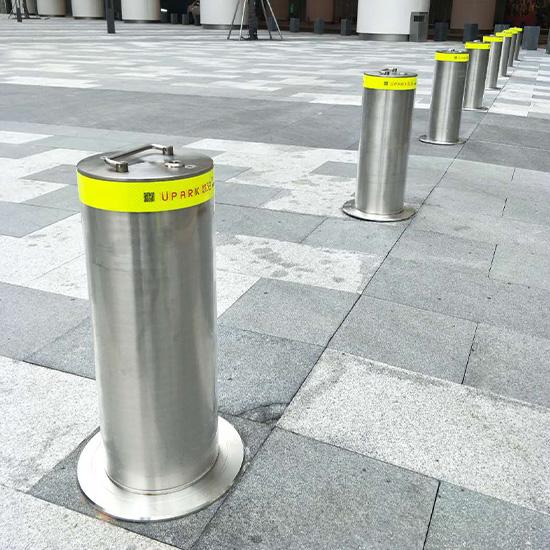
For high-throughput docks with dozens of movements per day, fast-cycle bollards are essential. UPARK electromechanical bollards complete a full rise or descent cycle in under 4 seconds and are rated for continuous duty cycle — tested to 1 million cycles without mechanical failure.
Warehouse perimeters are typically large, often with multiple vehicle access points, pedestrian gates, and fence lines that can be several hundred metres long. Protecting the full perimeter with crash-rated bollards is neither practical nor necessary — but protecting the key access points is.
The main vehicle entrance should have automatic bollards on the entry and exit lanes, with access control (intercom, access card, or security guard) for visitor and contractor vehicles. The exit lane may have crash bars or tyre spikes in addition to bollards for vehicles attempting to force exit.
Emergency exits need to allow rapid vehicle egress (fire engines, ambulances, emergency evacuation) without being permanently open. Automatic bollards configured fail-safe open (retract on power failure or fire alarm) satisfy this requirement.
Along fence lines where vehicle ram-raid is a concern — common in distribution centres storing high-value goods — a row of fixed crash-rated bollards set at 1.0 metre intervals provides continuous perimeter protection between the fence and the building.
Industrial environments are hard on equipment. Bollards in warehouses and logistics facilities face exposure to forklift impact, chemical spills, high-pressure washing, and constant heavy vehicle traffic. Material and finish selection matters.
For indoor industrial bollards, mild steel with powder coating is the standard — easy to repaint, economical to replace, high-visibility colour options available. For outdoor dock approaches and perimeter applications, stainless steel 304 or hot-dip galvanized steel with powder coating provides the corrosion resistance needed for long service life in rain, wash-down water, and de-icing salt environments.
For automatic bollards in industrial settings, specify IP67 or IP68 sealing. High-pressure wash-down during cleaning cycles is a common maintenance activity that will defeat an inadequately sealed bollard housing.
Large logistics facilities increasingly use WMS (warehouse management systems) and automated dock scheduling platforms. Bollards can be integrated to allow automatic vehicle entry when a dock appointment is confirmed in the system, rather than requiring a security guard to manually operate the barrier.
UPARK bollards support dry contact relay, RS485, and Wiegand interfaces. This is compatible with most commercial access control platforms and can be connected to WMS systems through a simple relay interface.
UPARK supplies bollard solutions for logistics parks, distribution centres, and industrial facilities worldwide. Our product range covers automatic bollards, fixed bollards, and removable bollards suitable for both interior and exterior industrial applications. Contact us for a site-specific product recommendation.
call us :
+86 18206096507 e-mail : [email protected]




 ipv6 network supported