Embassies, consulates, and government buildings are among the highest-risk venues for vehicle-borne threats. The political symbolism, the concentration of high-value targets, and the public accessibility of many diplomatic premises make them attractive targets for hostile vehicle attacks. The historical record — from the 1983 Beirut embassy bombings to more recent incidents — shows the consequences of inadequate vehicle barriers.
Vehicle access control for diplomatic and government facilities has evolved into a specialized discipline with its own standards, terminology, and procurement requirements. This article covers what you need to know when specifying bollard systems for high-security government applications.
Standard commercial bollards handle accidental vehicle incursion and traffic enforcement. High-security bollards are built for a different threat: a vehicle driven deliberately at speed, with the intent to reach the building or cause casualties at the perimeter.
The most widely used test standards for hostile vehicle mitigation (HVM) bollards are IWA 14-1 (ISO), PAS 68 (BSI), and ASTM F2656 (US). These standards define test vehicles, impact speeds, and penetration distances. The most demanding test level — M50/P1 under IWA 14-1, equivalent to a 7.5-tonne truck at 80 km/h — represents the threat level used for protecting embassies and critical national infrastructure.
For embassy applications, certification to IWA 14-1 or PAS 68 at M50/P1 or M50/P2 is the standard requirement. ASTM F2656 K12/P1 is the equivalent for US government facilities. Without a verified crash test certificate, a bollard cannot be considered HVM-rated regardless of how robust it appears.
One of the most important concepts in embassy security is standoff distance — the distance between the building and the point where a vehicle can be stopped. Increasing standoff distance reduces blast effect exponentially and gives security personnel more time to react to a vehicle threat.
Bollards at the outer perimeter create the first standoff line. In many embassy settings, space is limited — the building occupies most of the available plot, and the bollard line must be placed close to the building. In these cases, crash ratings and foundation depth become critical, because the bollard must absorb the full vehicle impact energy with minimal penetration.
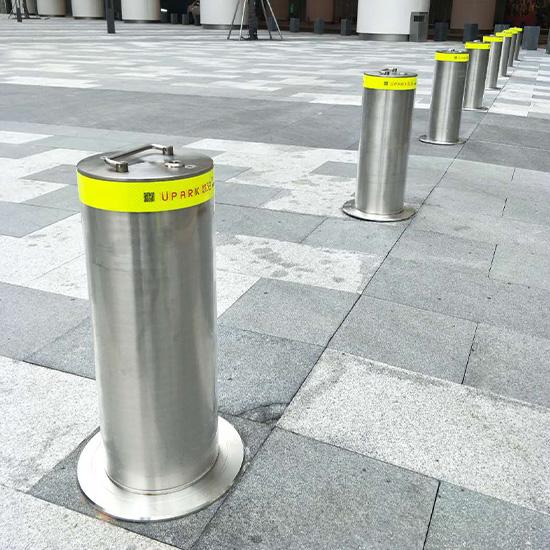
For inner perimeter bollards — between the main gate and the building entrance — the requirements shift from pure crash resistance to a combination of access control and vehicle channelling. Automatic rising bollards at the inner checkpoint allow authorized vehicles (diplomatic vehicles, approved contractors, supply vehicles) to enter the secured zone after identity verification.
Embassy vehicle access typically involves three categories of vehicle: diplomatic vehicles with authorized plates, contractor and delivery vehicles with pre-approved credentials, and visitor vehicles that require manual security screening.
The bollard system needs to support this tiered access model. Automatic bollards at the main vehicle gate are controlled from the guardhouse. Diplomatic vehicles may be recognized by license plate and granted automatic entry. Contractor vehicles are admitted after document checking and vehicle inspection. Visitor vehicles wait outside the bollard line until cleared.
Emergency egress is equally critical. In an emergency evacuation scenario, all barriers must be clearable quickly. Automatic bollards with emergency retraction capability — triggered by a dedicated switch in the security operations center — satisfy this requirement.
Crash-rated bollards require substantial foundations. An IWA 14-1 M50/P1 bollard must be anchored to a foundation capable of distributing and absorbing the impact forces from a 7.5-tonne truck. Foundation design for crash-rated bollards is a structural engineering matter, and the bollard manufacturer should provide a foundation drawing prepared by a qualified structural engineer.
Foundation depth typically ranges from 800 mm to 1,200 mm depending on the bollard model and soil conditions. The foundation block must be reinforced concrete with correct rebar specification. Undersizing the foundation invalidates the crash rating.
For retrofits — installing bollards at an existing facility without the ability to excavate a standard foundation depth — some manufacturers offer surface-mount crash-rated bollards with engineered base plates that distribute forces into the existing slab. UPARK can advise on retrofit options for constrained sites.
At an embassy, a bollard that malfunctions is not an inconvenience — it is a security incident. Operational reliability requirements for government applications are significantly higher than commercial standards.
Key reliability features to specify: duty cycle rating of at least 1 million operations (suitable for main entry gates processing hundreds of vehicles per day); backup power capability (UPS battery backup for continued operation during power outages); remote monitoring and diagnostic capability (so maintenance teams can identify faults before they cause operational failures); and MTBF (mean time between failures) documentation from the manufacturer.
Manual override capability is also essential. If the automatic system fails, security staff must be able to manually lower or raise the bollard. UPARK bollards include a manual hand pump override on hydraulic models and a mechanical release on electromechanical models.
Government procurement typically requires more documentation than commercial projects. Expect to provide: independent crash test certificates (not self-declarations), factory quality management certification (ISO 9001 minimum), material certifications for structural steel components, installation drawings with structural calculations, and operation and maintenance manuals in the required language.
UPARK supplies IWA 14-1 certified automatic bollards and fixed bollards for high-security government and diplomatic facility applications. We provide complete documentation packages including crash test certificates, structural drawings, and maintenance manuals. Our products have been installed at government facilities across the Middle East, Africa, and Asia. Contact us for technical specifications and project consultation.
call us :
+86 18206096507 e-mail : [email protected]




 ipv6 network supported