Stadiums and arenas concentrate large numbers of people in a small area on a predictable schedule. That combination — high density, known timing, public access — is exactly what makes them a recognized target for vehicle-based attacks, and it demands serious perimeter vehicle management.
But security is only half the problem. Stadiums also have significant operational vehicle management challenges: delivery trucks, team coaches, emergency services, broadcast vehicles, and thousands of private cars all competing for access in a narrow window before and after events. Getting bollards right means balancing security with operational flexibility.
After the 2017 Barcelona attack on Las Ramblas — where a van drove into a crowd killing 14 people — and similar incidents at Nice, Berlin, and Westminster Bridge, the protective security community recognized that crowded pedestrian areas needed physical vehicle barriers, not just police presence.
Stadiums and arenas are exactly the kind of venue these attacks target. On match days, thousands of spectators walk to the ground along pedestrian approaches, fill the surrounding streets hours before kick-off, and flood out after the final whistle. All of these approaches need vehicle access control.
The UK Centre for the Protection of National Infrastructure (CPNI) and equivalent agencies in other countries now publish guidance specifically for crowded places, including recommended bollard placement strategies for event venues. The core principle is creating an outer vehicle exclusion zone around the immediate pedestrian approach areas, with controlled access points for authorized vehicles.
A stadium is not always in use. On a typical week, a Premier League ground hosts one match. For the other six days, the same access points that need to be locked down on match day need to allow delivery vehicles, groundskeeping equipment, contractors, and administrative traffic to operate freely.
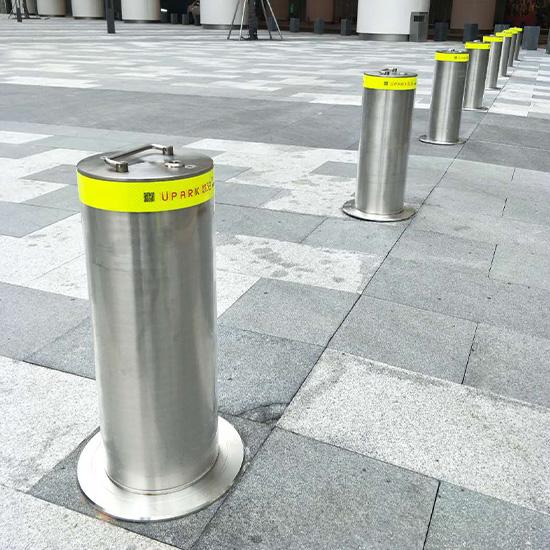
This is why automatic bollards are the dominant bollard type at major venues. On non-event days, they sit retracted, allowing normal vehicle access. On event days, they rise on a timed schedule (or manually via the security operations center) to create the exclusion zone around the pedestrian approaches. Emergency vehicles can retract them on demand via a central override.
Fast-cycle automatic bollards with a rise/lower time of under 4 seconds are particularly important at venues where vehicle flow needs to switch quickly between open and restricted modes.
The placement strategy depends on the venue geometry and the surrounding road network, but several general principles apply.
Pedestrian approach corridors — the routes spectators walk from transport links (train stations, bus stops, car parks) to the ground — are the highest-priority protection zone. A continuous line of automatic or fixed bollards along both sides of these corridors creates a protected walkway that vehicles cannot penetrate.
At road closures and pedestrian zones activated for events, automatic bollards are activated in sequence as the event start approaches and deactivated after crowds have dispersed. This allows the roads to function normally outside event windows.
Around the stadium perimeter itself, fixed bollards at 1.0–1.2 metre spacing along the kerb line provide permanent crowd separation from the road. These are visible every day (not just on event days) and serve as a constant physical barrier between the pedestrian concourse and any vehicle that might mount the kerb.
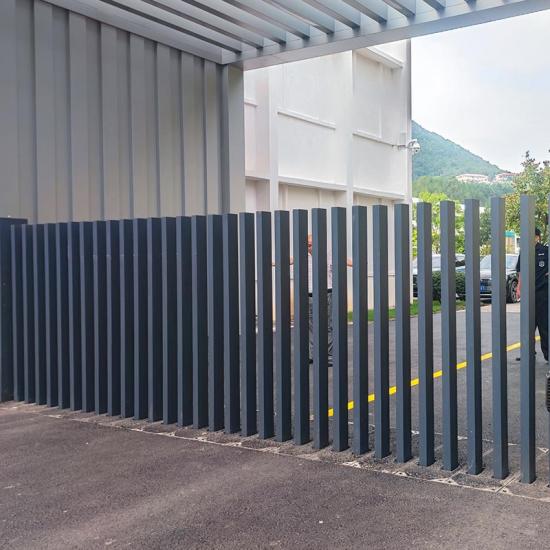
At authorized vehicle access points — players' entrance, media and broadcast vehicle access, delivery bay — automatic bollards control who can enter the inner perimeter. Access can be by staff card, intercom authorization, or central control room command.
Large events hosted at venues without permanent bollard infrastructure (outdoor concerts at parks, temporary stadia, road races) typically use temporary deployable water-filled barriers or temporary surface-mounted bollards. These are less effective than permanent foundations but provide a significant deterrent and some genuine protection.
For venues that host regular public events, permanent installed bollards are always preferable to temporary deployables. The deployment cost, logistics, and failure to deploy risk of temporary barriers add up quickly over a season. A permanent installation pays back within 2-3 seasons of events.
Installing bollards at an operational stadium or arena requires coordination with the venue's operations, security, and facilities management teams. Key questions to resolve during the design phase include: who controls the bollards on event day (security operations center, or individual touchpoints), how bollards integrate with the venue's existing access control and CCTV systems, what the maintenance schedule looks like given the high activation count during the event season, and how the system handles an emergency evacuation scenario.
UPARK has experience supplying bollard systems for sports venues and event facilities. Our automatic bollards support integration with event management and security platforms, and our engineering team can assist with placement design for complex site geometries. Contact us to discuss your venue's requirements.
call us :
+86 18206096507 e-mail : [email protected]




 ipv6 network supported