On 10–11 October 2026, a man climbed an eight-foot, barbed-wire perimeter fence at Denver International Airport and walked onto an active runway. Denver police detained him; no aircraft were harmed and the story cycled out of the news within a day. But for anyone responsible for airport, port, or critical-infrastructure security, the episode is a flashing warning light, not a footnote. A perimeter that is supposed to keep unauthorized people and vehicles out was crossed on foot in minutes, through a section that looked secure on paper. The breach exposed the oldest weakness in perimeter design: a fence is good at marking a boundary, but it is poor at enforcing one.
Fences are still the most common perimeter measure in the world, and they remain useful — but mainly as a visual and sensor carrier, not as a physical denial layer. Three limitations keep showing up in real incidents: They are climbable. An eight-foot fence with barbed wire slowed the Denver intruder by seconds, not minutes. They are cuttable. Bolt cutters and battery tools defeat chain-link and many welded-mesh designs in under a minute. They have blind spots. Long perimeters cannot be watched everywhere at once, and a fence gives no active resistance once it is crossed. The lesson is not that fences are useless. It is that a fence is a detection and delay signal, not a barrier. The delay it provides is too short to be the only thing between a threat and a runway, a fuel farm, or a control centre.
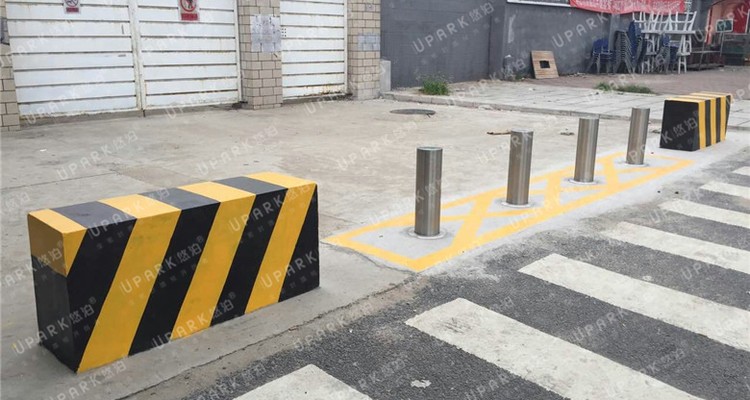
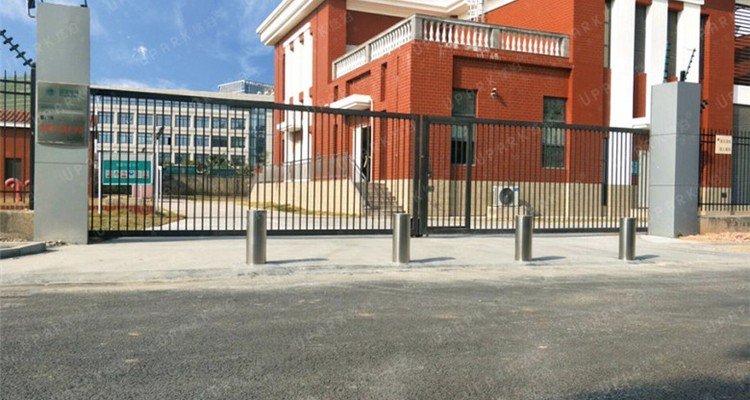
Modern perimeter security is built in layers, and each layer has a job: Detect — fences, sensors, CCTV and radar tell you something is happening. Delay — physical obstacles buy the minutes that response needs. Deny — engineered barriers stop a vehicle or person from reaching the protected asset at all. Most sites over-invest in detection and under-invest in denial. A crash-rated automatic bollards is the cheapest, most reliable way to add a true denial layer at the exact points where vehicles are meant to pass: service roads, ID checkpoints, fuel and power zones, cargo areas and perimeter vehicle gates.
Airports cannot wall themselves off — they need vehicles moving constantly between aprons, terminals, fuel depots and maintenance areas. That is exactly why automatic bollards beat fixed ones for airside use: they rise and lower on command, integrate with access control, and present zero obstacle to authorized traffic during operations while becoming an immovable wall the moment they are raised. High-value placements include: employee and contractor ID checkpoints, fuel and hydrant zones, emergency-service access roads, cargo and courier gates, and any perimeter roadway that parallels the airfield fence. After an event like the Denver breach, insurers and regulators increasingly ask the simple question — if a vehicle tried to drive through that opening, what physically stops it? A bollard is the honest answer.
A security bollard is only as good as the standard it is tested to. The three globally recognised benchmarks are PAS 68 (UK), IWA 14-1 (international, the successor to the old PAS 70) and ASTM F2656 (USA). Each defines how a bollard must perform when hit by a vehicle of a given mass at a given speed. A typical rating such as V/7200[N3]/80/90 means a 7.5-tonne truck travelling at 80 km/h was stopped with less than 90 cm of penetration. Specifying to a tested rating — rather than buying a decorative post — is the difference between a perimeter that looks secure and one that is proven secure. For airport and critical sites, PAS 68 / IWA 14 rated bollards should be the baseline, not the premium option.
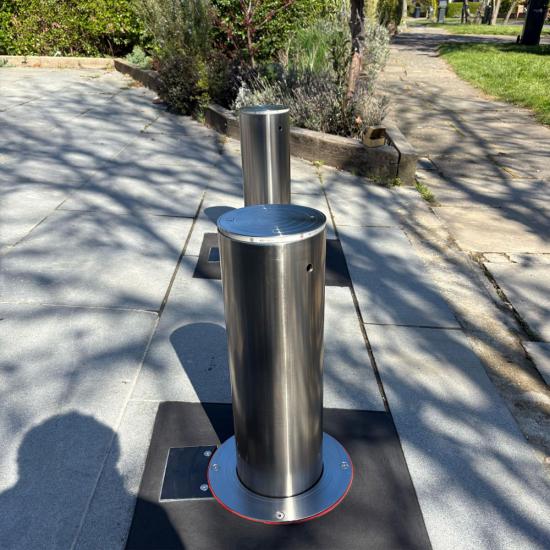
UPARK automatic bollards are built around a 36V electromechanical screw-driven mechanism. That matters for airside and public sites in three ways. Safety: low-voltage 36V operation removes high-voltage hazards and needs no pressurised fluid, so there is nothing to leak or freeze. Legacy hydraulic drives, by contrast, carry high-pressure fluid and higher-voltage risk — a trade-off this electromechanical design avoids. Reliability: with an IP67 waterproof rating, the units operate in rain, snow and flood-prone areas where older fluid-filled designs fail. Compliance-ready: UPARK offers crash-rated (PAS 68 / IWA 14 / ASTM F2656) configurations and integrates with RFID, license-plate recognition and access-control systems already used at airports and government sites. The result is a denial layer that is engineered, certified and maintainable — not a fence with wishful thinking attached.
If the Denver breach prompted a review at your site, start here: 1) Map every vehicle opening in the perimeter and ask what stops a vehicle there today. 2) Prioritise fuel, power, ID-checkpoint and cargo gates for engineered HVM. 3) Specify PAS 68 / IWA 14 rated bollards, not decorative posts. 4) Integrate bollards with access control so authorized traffic flows and unauthorized traffic is blocked. 5) Document the design for insurers and regulators. A fence tells you someone is coming. A crash-rated bollard makes sure they do not arrive.
The Denver incident was caught in time. The next one might not be. Perimeter security has moved past the idea that a fence is a barrier; it is a sensor. The denial layer — the thing that actually stops a vehicle or intruder — now belongs to engineered, crash-rated automatic bollards. If you are reviewing airfield, port or critical-site perimeter after this event, contact the UPARK team to discuss a PAS 68 / IWA 14 rated layout sized to your openings and threat profile.
call us :
+86 18206096507 e-mail : [email protected]




 ipv6 network supported