Vehicle-borne attack is one of the most persistent threats to public life. It needs no specialist weapon, no explosives license and no training — only a vehicle and a crowded, open space. From markets and festivals to waterfronts and transit plazas, the places we gather are also the places most exposed. What is changing in 2026 is not the threat. It is the response. Anti-vehicle barriers and automatic bollards are shifting from a premium, after-the-incident add-on to a normal part of how public space is designed — backed by new research and a continent-wide move toward car-free cities.
In the United States, George Mason University was awarded roughly US$1.43 million in Federal Highway Administration (FHWA) funding to study anti-vehicle perimeter barriers — research into how engineered barriers actually perform and how they should be specified for roads, campuses and public sites. That matters because HVM has long suffered from guesswork: posts that look strong but were never tested, or ratings quoted without the standard behind them. Independent, federally funded research pushes the whole sector toward evidence-based design — and toward specifying barriers by proven performance (PAS 68 / IWA 14 / ASTM F2656) rather than appearance. When the science says a tested bollard stops a 7.5-tonne truck at 80 km/h, planners can design with confidence instead of hope.
Across Europe, city centres are removing cars from streets and squares to reclaim space for people. The intent is welcome — cleaner, safer, more livable cities — but pedestrianization creates a paradox: a car-free zone is only car-free if something stops a vehicle from driving into it. This is where automatic bollards earn their place. A pedestrianized square can stay open to people all day and still admit emergency vehicles, maintenance trucks and market deliveries through bollards that lower on command and rise again afterward. Without that control, a “pedestrian zone” is just an unguarded street. The 2026 wave of walkable-city projects is, quietly, one of the biggest drivers of bollard demand in a decade.
Not every post in the ground is a barrier. A crash-rated bollard is one tested to a recognised standard: PAS 68 (UK), IWA 14-1 (the current international standard) and ASTM F2656 (USA). Each rates performance by vehicle mass, speed and allowed penetration. A rating such as V/7200[N3]/80/90 certifies that a 7.5-tonne vehicle at 80 km/h was stopped with under 90 cm of penetration. For specifiers, the rule is simple: match the rating to the threat. A quiet civic square may need a lower rating than a government forecourt or a transit plaza facing a fast approach road. The point is to choose a tested number, not a decorative look.
Four families cover almost every site: Fixed bollards — permanent denial at frontages and pedestrian zones. Automatic / retractable bollards — flexible access for deliveries, events and emergencies; the workhorse for mixed-use public space. Manual bollards — lower-cost control where access changes rarely. Removable bollards — occasional-access points such as seasonal event routes. Most modern projects combine types: fixed lines along a façade, automatic rows at vehicle gates. The mix is dictated by how often each opening must let a vehicle through.
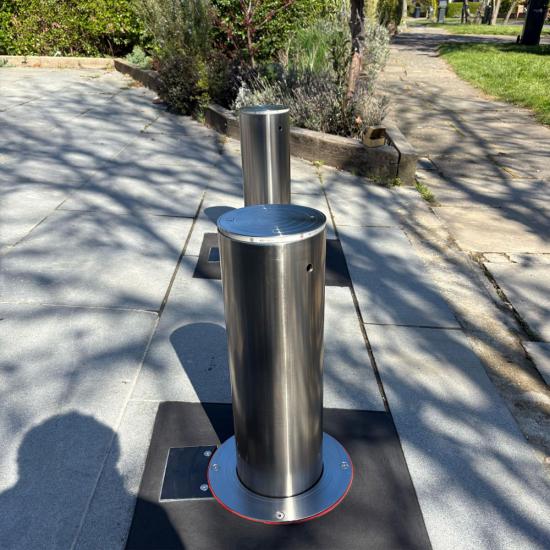
UPARK automatic bollards use a 36V electromechanical screw-driven mechanism. For public-space and civic deployments this has concrete advantages over legacy fluid-filled drives: Safer: low-voltage 36V operation avoids high-voltage hazards and pressurised-fluid risks. Cleaner: there is no fluid to leak into streets, squares or drains. Reliable: an IP67 waterproof rating keeps units working through rain, snow and flooding. Certifiable: PAS 68 / IWA 14 / ASTM F2656 rated options are available, so a UPARK layout can be specified on tested performance, not appearance. As HVM becomes baseline, buyers want the control that is safe to live next to, easy to maintain and proven to work. Electromechanical answers all three.
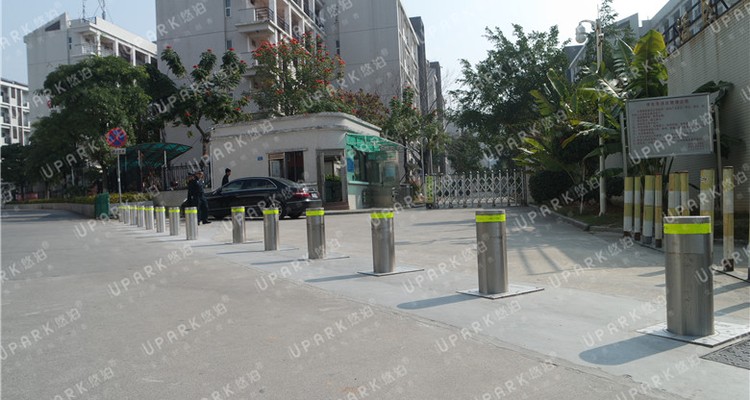
A credible 2026 HVM specification follows five steps: 1) Risk-assess vehicle approach routes and crowd spaces. 2) Choose a tested rating (PAS 68 / IWA 14 / ASTM F2656) matched to the threat. 3) Pick bollard types by how often each opening needs vehicle access. 4) Integrate automatic units with access control and emergency override. 5) Document the design for insurers, regulators and future maintenance. Done well, the barrier disappears into the streetscape — until the day it is the only thing between a crowd and a threat.
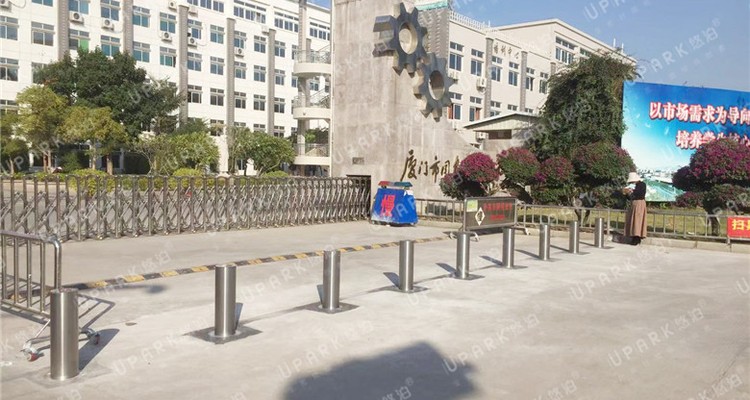
Hostile vehicle mitigation used to be something a site considered after an incident. In 2026, with federal research validating barrier performance and cities redesigning themselves around people rather than cars, it is becoming the default. Crash-rated automatic bollards are the practical expression of that shift: open when they should be, immovable when they must be, and proven by standard rather than by luck. To plan a rated layout for your square, campus or transit plaza, contact the UPARK team and we will size it to your threat, your traffic and your standards.
call us :
+86 18206096507 e-mail : [email protected]




 ipv6 network supported