When planning a vehicle access control system, one of the most critical decisions you'll face is choosing between electric (electro-mechanical) and hydraulic automatic bollards. This choice affects not only your upfront budget but also long-term maintenance costs, installation complexity, and operational reliability.

This guide breaks down every factor you need to consider — with real data from industry-leading manufacturers including UPARK, Frontier Pitts, and others.
| Use Case | Recommended Type | Why |
|---|---|---|
| Commercial plazas, parking lots, schools | Electric | High cycle frequency, low maintenance |
| High-security / anti-terror facilities | Hydraulic (or certified electric) | Maximum impact resistance required |
| Cold climates (below -20C) | Hydraulic or specialized electric | Fluid viscosity concerns |
| Remote locations | Electric | Simpler system, fewer failure points |
| Budget-conscious projects | Electric | Lower total cost of ownership |
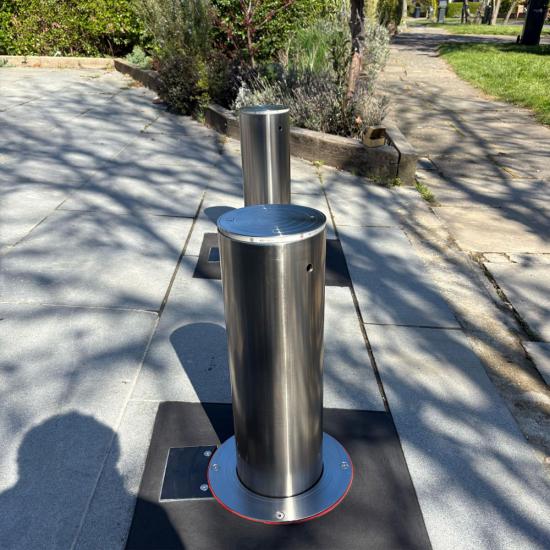
An electric bollard uses a motor and mechanical drive system (typically screw jack or gear mechanism) to raise and lower the bollard post. When powered on, the motor drives the internal mechanism to extend the bollard above ground; when powered off (or in emergency mode), it retracts.
Key components:
A hydraulic bollard uses a pump-driven hydraulic fluid system to actuate the bollard. An electric pump pressurizes hydraulic fluid, which then drives a hydraulic cylinder to push the bollard up or down.
Key components:
| Factor | Electric Bollards | Hydraulic Bollards |
|---|---|---|
| Drive Mechanism | Motor + mechanical gears | Pump + hydraulic fluid + cylinder |
| Lift Speed | 3-6 seconds typical | 3-9 seconds typical |
| Duty Cycle | Up to 100% (continuous) | Up to 100% (with proper cooling) |
| Operating Temperature | -30C to +70C (with heating option) | -20C to +55C (fluid-dependent) |
| Maintenance | Minimal - lubrication check annually | Fluid changes, hose inspection, seal replacement |
| Risk of Leakage | None | Possible (hoses, seals, cylinder) |
| Noise Level | Low (50-65 dB) | Moderate (60-75 dB) |
| Installation Complexity | Simple - single pit per bollard | Complex - bollard pit + control cabinet foundation |
| Control Cabinet Size | Compact (can be integrated) | Large (separate, needs dedicated space) |
| Power Consumption | 200W-600W per operation | 750W-2200W per operation |
| Upfront Cost | $1,500 - $4,000 per unit | $3,000 - $8,000+ per unit |
| 10-Year Maintenance Cost | ~$200-$500 | ~$1,500-$4,000 |
| Environmental Impact | No fluids to dispose of | Hydraulic fluid disposal required |
| IP Rating Available | IP67/IP68 (fully submersible) | Typically IP54-IP67 |
This is where the two systems differ most dramatically.
| Task | Frequency | Cost | Difficulty |
|---|---|---|---|
| Visual inspection | Monthly | Free | Easy |
| Clean bollard surface | Quarterly | Free | Easy |
| Check limit switches | Annually | $0-$50 | Medium |
| Lubricate gears/mechanism | Annually | $0-$100 | Medium |
| Electrical connection check | Annually | $0-$100 | Medium |
| Total annual cost per unit | ~$50-$250 |
| Task | Frequency | Cost | Difficulty |
|---|---|---|---|
| Visual inspection | Monthly | Free | Easy |
| Check fluid level | Monthly | Free | Medium |
| Inspect hoses for wear/leaks | Quarterly | $0-$150 | Hard |
| Check hydraulic pressure | Quarterly | $50-$200 | Hard |
| Replace hydraulic filter | Annually | $100-$300 | Hard |
| Change hydraulic fluid | Every 2-3 years | $200-$500 | Very Hard |
| Replace seals & gaskets | Every 3-5 years | $300-$800 | Very Hard |
| Inspect/replace hoses | Every 5 years | $200-$600 | Hard |
| Total annual cost per unit | ~$400-$1,200 |
Over a 10-year lifespan, a hydraulic bollard can cost $4,000-$12,000 more in maintenance than an equivalent electric model.
Typical Foundation (per bollard):
Typical Foundation:
Real-world example: Frontier Pitts specifies an 800mm x 880mm deep bollard foundation PLUS a separate 800mm x 300mm deep control cabinet foundation.
Let's compare a 3-bollard installation over 10 years:
| Cost Category | Electric (3 units) | Hydraulic (3 units) |
|---|---|---|
| Equipment cost (per unit avg) | $2,500 | $5,500 |
| Subtotal equipment | $7,500 | $16,500 |
| Civil works & installation | $3,000-$6,000 | $6,000-$12,000 |
| Control system & integration | $1,500-$3,000 | $2,000-$4,000 |
| Annual maintenance (x10) | $1,500-$7,500 | $12,000-$36,000 |
| Spare parts reserve | $500 | $2,000 |
| 10-Year TCO | $14,000-$24,000 | $38,500-$70,500 |
| Savings with Electric | - | $14,500-$46,500 (38-66%) |
Despite the advantages of electric systems, hydraulic bollards remain the right choice for certain scenarios:
Important note: Modern high-quality electric bollards (such as those tested to IWA 14-1 and PAS 68 standards) now meet crash-rating requirements that were previously exclusive to hydraulic systems. Always verify certification regardless of drive type.
Before making your decision, run through this checklist:
The bollard industry is evolving rapidly. Here's what's new:
For the majority of commercial, institutional, and public-space applications in 2026, electric (electro-mechanical) bollards offer the best combination of low total cost, minimal maintenance, simple installation, and reliable performance.
Hydraulic systems retain their place in specialized high-security and ultra-high-cycle scenarios, but the gap continues to narrow as electric technology improves.
The bottom line: Don't default to hydraulic just because "that's what we've always used." Run the numbers for your specific project - you may find that modern electric bollards deliver everything you need at a fraction of the lifecycle cost.
About UPARK
UPARK (Xiamen Meihao Chuxing IoT Technology Co., Ltd.) has been a leading manufacturer of automatic rising bollards since 2004. Our electro-mechanical bollard systems feature:
With installations across 60+ countries and a reputation for reliability, UPARK delivers professional-grade perimeter security at competitive prices.
Contact us: [email protected] | Website: www.uparkbollards.com

call us :
+86 18206096507 e-mail : [email protected]




 ipv6 network supported