Why Government Buildings Attract Threats
Government buildings are high-profile targets. They house the machinery of governance, hold sensitive records, and often contain the offices of officials who make controversial decisions. A protest that turns violent, a disgruntled former employee with a grudge, or an ideological attacker looking for maximum visibility—any of these can use a vehicle as a weapon with devastating effect.
The challenge for government facility managers is that these buildings also serve the public. A city hall is supposed to be accessible to citizens. A courthouse needs lawyers and jurors to enter freely. A social services office cannot operate behind blast walls. The solution requires layers: perimeter controls to stop vehicles at a distance, entry controls to manage access points, and internal barriers to protect the most sensitive areas.
Bollards fit into the first two layers. They are one of the few security measures that can stop a vehicle without permanently blocking pedestrian and legitimate vehicle access.
Perimeter Setback: Creating a Safety Zone
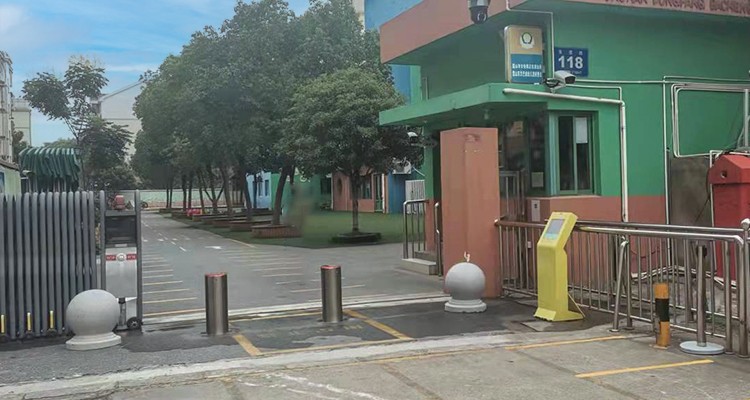
The most effective bollard strategy starts at the perimeter. Rather than installing bollards right at the building entrance, many government facilities establish a vehicle exclusion zone around the entire building footprint. This setback—often 10 to 30 meters depending on the threat level—gives security forces time to detect and respond to an approaching vehicle before it reaches the building.
For this outer perimeter, fixed crash-rated bollards are the standard choice. They should be specified to the threat level established by the facility's security assessment. Most municipal buildings use IWA 14-1 M30 or K4 ratings, which stop a 6,800 kg truck at 48 km/h. High-security facilities like federal courthouses or intelligence buildings may require M50 or K12 ratings capable of stopping a 15,000 kg truck at 80 km/h.
The fixed bollard installation at the perimeter is permanent, which means it must be planned carefully. Utility lines, drainage, sidewalk layouts, and landscaping all need to be considered. The foundation depth must be adequate for the crash rating, and the bollard spacing must be tight enough to prevent a vehicle from passing through.
Controlled Entry Points and Sally Ports
Inside the perimeter, vehicle access points are controlled. These are the gates and sally ports where vehicles are inspected before being allowed through. The bollards here are typically automatic, operated by security staff or integrated with the vehicle inspection system.
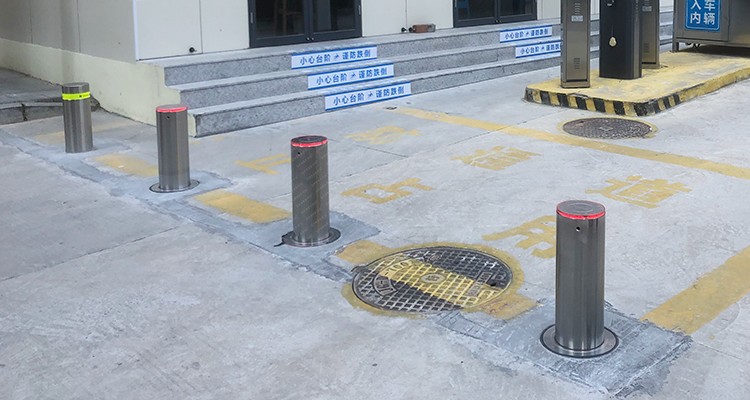
A sally port is a gated entry with two doors that never open simultaneously. When one opens, the other remains closed, creating a secure chamber where vehicles can be inspected before proceeding. Bollards at the exit of the sally port control whether a cleared vehicle is allowed through. This prevents a scenario where an unauthorized vehicle breaches the outer gate and races into the facility.
Automatic bollards at these checkpoints need to operate reliably under continuous use. High-duty-cycle applications benefit from electromechanical drives rather than hydraulic systems, since electromechanical units have fewer moving parts that can fail and do not require hydraulic fluid maintenance.
Courthouses and Judicial Facilities
Courthouses present specific challenges because they combine high security requirements with an obligation to remain open to the public. Defendants, lawyers, jurors, witnesses, and observers all need access, but they need to be separated from each other and from the judge and court staff.
Vehicle barriers around the perimeter of the courthouse grounds prevent cars and trucks from approaching the building. Inside, fixed bollards at pedestrian entrances and courtyard areas prevent vehicles from accessing areas where large groups of people gather. The distinction between a vehicle barrier and a bollard is important here: bollards stop vehicles but allow pedestrians through freely, whereas a jersey barrier stops everything.
For government facilities of all types, the key is a security plan that matches the actual threat profile. Over-engineering costs money and creates inconvenience; under-engineering invites tragedy. A professional security assessment is the right starting point for any government building considering bollard installation.
call us :
+86 18206096507 e-mail : [email protected]




 ipv6 network supported