The Security Paradox at Hospitals
Hospitals have an impossible job when it comes to access control. They need to be open 24 hours a day, seven days a week. Emergency vehicles must be able to reach the ER instantly. Patients in crisis need to get through the door without delays. Staff work around the clock and need parking access. Meanwhile, hospitals also contain expensive medical equipment, pharmaceutical supplies, sensitive patient records, and VIP patients who may be targets.
This creates a paradox: you cannot screen every vehicle the way you would at an airport or government building, because a hospital's purpose is to serve anyone who walks through its doors. The solution is not stricter access controls but smarter physical design—using barriers to channel vehicle traffic while keeping the highest-risk areas protected.
Bollards are one of the most effective tools in this approach. They create invisible lanes that guide authorized traffic while blocking unauthorized approaches. They work 24/7 without needing a guard to watch them, and they do not discriminate between a delivery truck and a weapon.
ER Bays and Emergency Vehicle Access
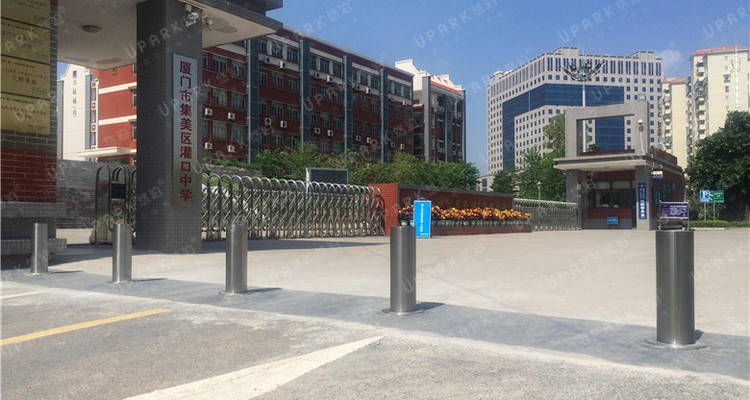
The emergency department entrance is the most critical point in any hospital. Ambulances need to pull in without hesitation, stretchers need to move in and out quickly, and the area in front of the bay needs to stay clear of private vehicles at all times.
Automatic bollards at the entrance to the ambulance bay solve this problem elegantly. When an ambulance arrives, the bollards lower automatically via a priority signal from the emergency vehicle system. Private vehicles cannot follow in because the bollards rise again immediately after the ambulance passes. The result is a lane that functions as an emergency corridor during arrivals and a barrier the rest of the time.
For hospitals that have not yet automated this integration, manual override systems allow security staff to lower the bollards on demand. Some facilities use removable bollards with a key system, which is less convenient but equally effective for controlling access.
Helicopter Pads and Critical Infrastructure
Hospitals with helicopter pads face a specific security challenge. The pad itself is usually on the roof or a secured ground-level zone, and the approach paths need to be clear of obstructions. But the pad also needs protection from unauthorized access and potential vehicle attacks.
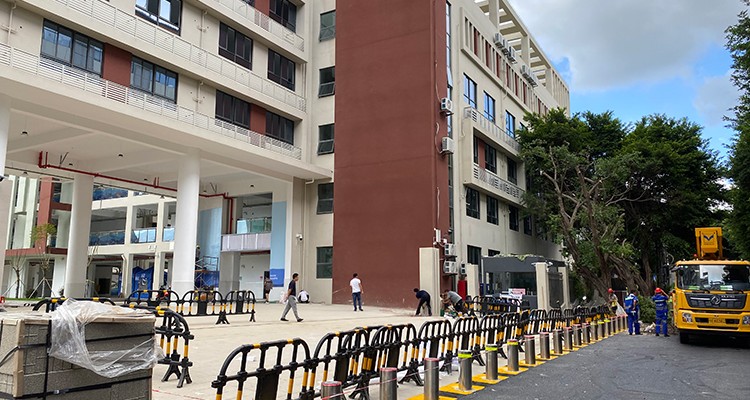
Fixed crash-rated bollards around the perimeter of the helicopter pad create a protective zone that meets aviation security guidelines. These bollards are typically specified to stop a vehicle matching the IWA 14-1 M30 or M50 rating, depending on the threat assessment. They are always in position, require no power or maintenance beyond periodic inspection, and do not interfere with helicopter operations.
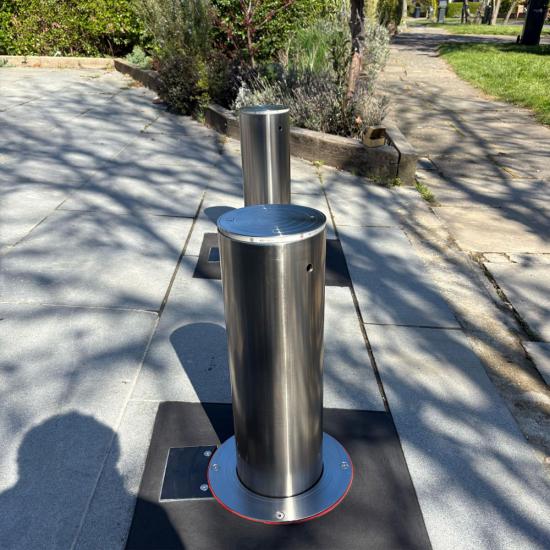
Inside the hospital, sensitive areas like pharmaceutical storage, medical gas facilities, and electrical rooms benefit from additional bollard protection. Fixed stainless steel bollards at these locations prevent vehicles from getting close enough to cause catastrophic damage, even if the hospital is breached at the perimeter level.
Patient Areas and Public Spaces
Waiting rooms, main entrances, and outdoor patient gardens are places where vehicles accidentally or deliberately entering could cause mass casualties. These areas are designed for pedestrian access, with wide pathways, outdoor seating, and low curbs that make them accessible to wheelchairs and mobility devices.
The trick is protecting these areas without making them feel clinical or unwelcoming. Decorative bollards that match the hospital's architectural style—often in warm metal finishes or custom colors—provide security while maintaining the aesthetic that hospitals work hard to project. Automatic bollards at the vehicle entry points to these areas can be programmed to lower during specific hours when drop-off traffic is expected and rise during quieter periods.
Hospital security planners should treat bollard installation as essential infrastructure rather than an optional upgrade. The relatively low cost of a bollard system compares favorably to the potential consequences of an unprotected vehicle incursion at a facility where vulnerable people gather in large numbers.
call us :
+86 18206096507 e-mail : [email protected]




 ipv6 network supported