One of the first questions any installer asks when planning a bollard project is: how deep does the foundation need to be? The answer you get usually starts with a number and ends with a caveat. That caveat, more often than not, involves drainage.
For fixed bollards, the calculation is simple. Most specifications call for a foundation depth of three to four times the above ground height of the post. A 900mm high fixed bollard typically needs a foundation depth of around 600mm to 900mm. The concrete tube or pad provides enough resistance to stop a vehicle at low to moderate speeds. The calculation is well understood and consistently applied across the industry.
For traditional automatic rising bollards, the depth requirement changes dramatically. The mechanism needs to fit below ground level, which means the pit must be deep enough to house the retracted bollard plus the lifting mechanism beneath it. For a typical hydraulic unit, that puts the pit bottom at 1000mm to 1200mm. But then you need to add the drainage layer. A gravel bed of 150mm to 200mm, a perforated pipe, and connection space below that. Suddenly the total excavation depth is pushing 1200mm to 1500mm. In areas with deep frost lines, it can go even further.
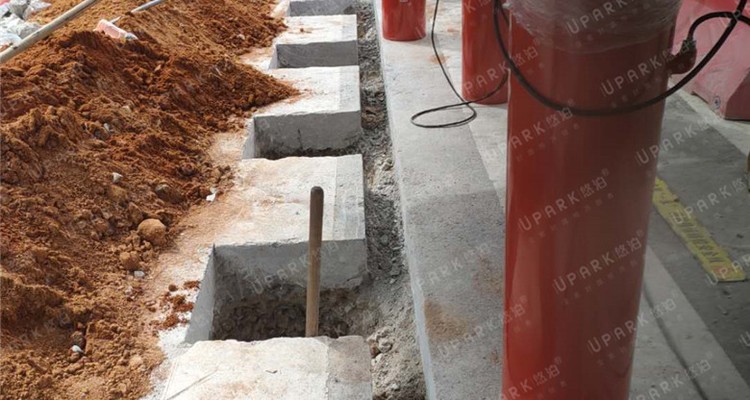
That extra depth creates a cascade of complications. Deeper excavation means more soil to remove and dispose of. It means potentially hitting the water table in coastal or low lying areas, which then requires dewatering before the foundation can be poured. It means larger concrete volumes and more rebar. It means excavating around existing underground utilities that might be running at exactly the depth you need to reach. Every additional hundred millimeters of depth increases the risk of hitting something you did not plan for.
Sealed IP67 automatic bollards take the foundation requirement back toward the fixed bollard range. Because there is no drainage system to accommodate, the foundation only needs to be deep enough to house the retracted mechanism and provide sufficient structural support. For most UPARK electromechanical models, that means a foundation depth of around 800mm to 1000mm. The unit drops into a pre formed sleeve, and the concrete provides the anchoring and structural support.
The difference between 1000mm and 1400mm might not sound dramatic on paper, but on site it is a different story. That 400mm reduction per bollard means less time on the excavator, less concrete per pour, less soil to truck away, and less risk of utility conflicts. On a project installing a row of fifteen bollards along a driveway, the cumulative savings in excavation alone can trim a full day off the schedule. For projects working in urban environments where road closures are timed to the hour, that kind of schedule saving has direct financial value.
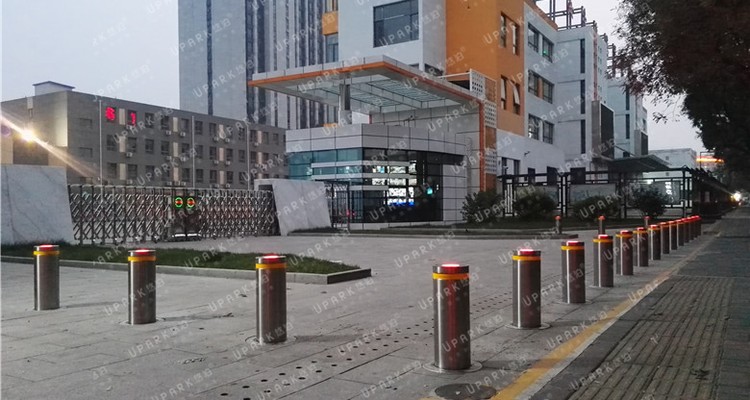
Crash rated installations require special consideration. Bollards that need to stop a 7.5 tonne vehicle at 50 km/h, the M50 or K12 classification, need substantially deeper and more heavily reinforced foundations regardless of the bollard type. The foundation for these units typically starts at 1200mm even for sealed systems, because the structural requirements of stopping a fast moving heavy vehicle demand it. But even in this category, the sealed design saves depth by eliminating the drainage layer. A crash rated sealed bollard might need 1200mm of foundation depth, while an equivalent traditional unit needs 1500mm to 1700mm to accommodate both the crash rated structure and the drainage system below it.
The foundation depth also affects the type of equipment needed for installation. Excavation below 1000mm can often be handled by compact excavators or even manual digging in tight spaces. Going deeper than 1200mm usually requires larger machines with longer reach, which may not fit in constrained urban sites like narrow lanes or underground parking structures. Sealed bollards keep the excavation in the range that smaller equipment can handle, opening up installation possibilities in locations where traditional bollards simply cannot fit.
For anyone specifying bollards for a project, asking about foundation depth at the beginning of the planning stage can prevent costly surprises later. The difference between needing drainage and not needing it is not a minor detail. It reshapes the entire civil works scope, from excavation volume to equipment selection to project timeline. Understanding that distinction early helps everyone involved, from the architect to the contractor to the client, make better decisions about which system fits the site and the budget. You can also read about the seven key advantages of sealed installations in this comprehensive guide.
call us :
+86 18206096507 e-mail : [email protected]




 ipv6 network supported