When you specify automatic rising bollards for a project, one of the earliest decisions you face is the drive mechanism. The three options — hydraulic, electromechanical (electric), and pneumatic — each have distinct strengths and weaknesses. The wrong choice means higher costs, more maintenance, or a system that cannot handle the operating conditions.
Hydraulic bollards use pressurized hydraulic fluid to drive the bollard up and down. An electric motor powers a hydraulic pump that pushes oil into a cylinder, lifting the bollard. To lower it, a valve opens and the bollard descends under its own weight. Most hydraulic setups use a central power unit (HPU) connected by hoses to multiple bollards.
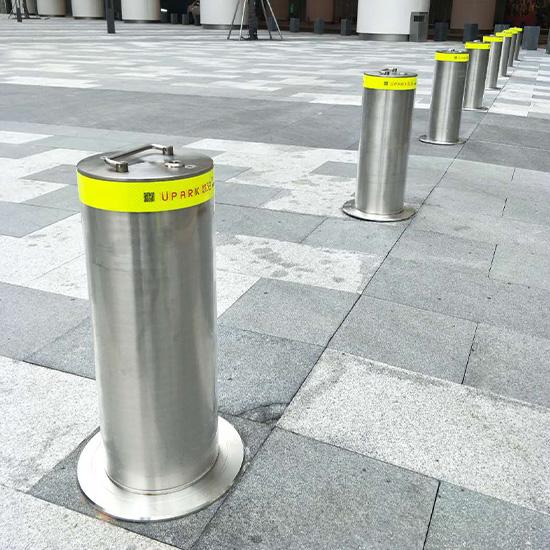
Electromechanical bollards use an electric motor connected to a mechanical drive, typically a worm gear and lead screw assembly. The motor turns the screw, which pushes the bollard up or pulls it down. The worm gear self-locking property holds the bollard in position. Each bollard has its own motor, so there is no central pump.
Pneumatic bollards use compressed air. A compressor fills a storage tank, and when a signal is sent, an electromagnetic valve routes compressed air into a cylinder that pushes the bollard upward. Like hydraulic systems, pneumatic bollards typically share a central compressor station.
Hydraulic bollards typically rise in 2 to 6 seconds and lower in 1.5 to 3 seconds. An emergency fast operation (EFO) mode can raise the bollard in about 1.5 seconds.
Electromechanical bollards typically rise in 3 to 9 seconds. The Madoors MB-4000, a crash-rated electromechanical model, rises in 3 seconds in normal mode and 1.5 seconds in emergency mode.
Pneumatic bollards rise in 1.5 to 6 seconds. Compressed air responds quickly, but the motion has less cushioning than hydraulic operation.
Electromechanical bollards handle high-frequency use well. The Madoors MB-4000 is rated for 200 operations per hour. The StopGrup model handles up to 360 per hour. Electromechanical systems are well-suited for 24/7 continuous operation.
Hydraulic bollards can handle high frequency but are limited by oil temperature buildup. Continuous operation heats the hydraulic fluid, and once it exceeds its rated temperature, the system needs a cooldown period.
Pneumatic bollards have the widest operating temperature range. The Arma Kontrol HB-P operates from -25 degrees C to +60 degrees C. Compressed air does not thicken or freeze the way hydraulic oil does.
Electromechanical bollards typically operate from -15 degrees C to +50 degrees C. Because there is no fluid medium, cold temperatures do not materially affect performance.
Hydraulic bollards typically operate from -20 degrees C to +55 degrees C. The weak point is the hydraulic oil. Below about -10 degrees C, manufacturers recommend anti-freeze hydraulic oil or an electric heating element.
Hydraulic bollards typically hold their position during a power failure because the hydraulic check valve traps the oil in the cylinder. A manual release valve allows authorized personnel to lower the bollard by hand.
Electromechanical bollards generally lower automatically on power failure (fail-safe design). The worm gear holds position when power is on but releases under gravity when the motor stops.
Pneumatic bollards maintain position as long as pressure remains in the system. Once the residual pressure bleeds off, the bollards will slowly descend.
Electromechanical bollards are the simplest to install. Each bollard is self-contained, needing only a power cable. UPARK electromechanical bollards operate on 36V safety voltage, which simplifies electrical compliance. Annual maintenance costs are typically $100-$300 per unit.
Hydraulic bollards require more infrastructure: central HPU, hydraulic lines, drainage system. Foundation depth is typically 1.0 to 1.5 meters. Annual maintenance costs are typically $300-$800 per unit.
Pneumatic bollards need a central compressor station, air storage tank, air treatment equipment, and air lines. Annual maintenance costs are typically $200-$500 per unit.
For a 3-bollard system:
For high-security and anti-terror applications (K12/M50 crash rating), hydraulic is still the standard choice. The power density of hydraulics allows the strongest bollard designs.
For high-traffic commercial applications (office parks, parking facilities, logistics centers), electromechanical is hard to beat. Low noise, low maintenance, simple installation, and high duty cycle capability. It is also the best option for residential driveways because of quiet operation and 36V low-voltage systems.
For extreme cold climates, pneumatic has a genuine advantage. If temperatures regularly drop below -20 degrees C, pneumatic bollards avoid the hydraulic oil viscosity problem entirely.
For coastal and corrosive environments, electromechanical bollards with full IP68 sealing have the edge. No hydraulic oil means no leak risk.
UPARK manufactures all three drive types and can help you specify the right system for your project. Contact us with your project details for a tailored recommendation and quotation.
call us :
+86 18206096507 e-mail : [email protected]




 ipv6 network supported