Why Ports Are Hard to Secure
Ports and harbors face a security challenge that few other facilities have to deal with. They are vast, often covering hundreds of hectares, with boundaries that run along coastlines, rivers, or canal banks. They have dozens of access points for trucks, rail cars, ships, and port workers. And they handle some of the most dangerous cargo in the world: explosives, chemicals, liquefied natural gas, and containers whose contents are sometimes unknown even to the terminal operator.
The sheer volume of traffic adds another layer of difficulty. A major container port might process 10,000 truck movements per day. Every gate, every road, and every intersection within the port is a potential point where a vehicle could be used as a weapon, either deliberately or through loss of control. Unlike an airport, where most vehicle access is funneled through a handful of controlled entry points, ports have a sprawling road network that is much harder to control.
On top of all this, ports sit in corrosive marine environments. Salt air, humidity, and occasional flooding mean that any security equipment installed here has to be built to last in conditions that would quickly degrade standard products.
Key Areas That Need Bollard Protection
Not every corner of a port needs the same level of physical security. The practical approach is to identify high-value or high-risk zones and protect those first, then extend coverage as budgets allow.

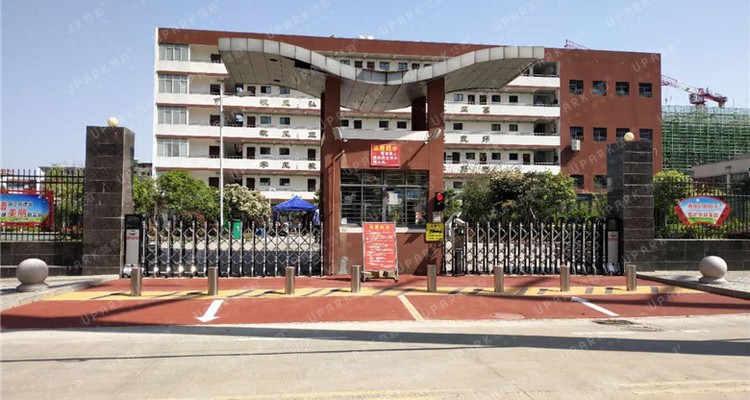
The terminal gate area is the obvious starting point. This is where trucks enter and exit the port, and where the flow of vehicles needs to be managed without creating delays that slow down the supply chain. Automatic bollards here serve a dual purpose: they enforce vehicle access control during operating hours and provide a physical barrier when the terminal is closed. Pairing them with parking barriers creates a staged access system where vehicles are checked at the barrier and then funneled through bollard-protected lanes.
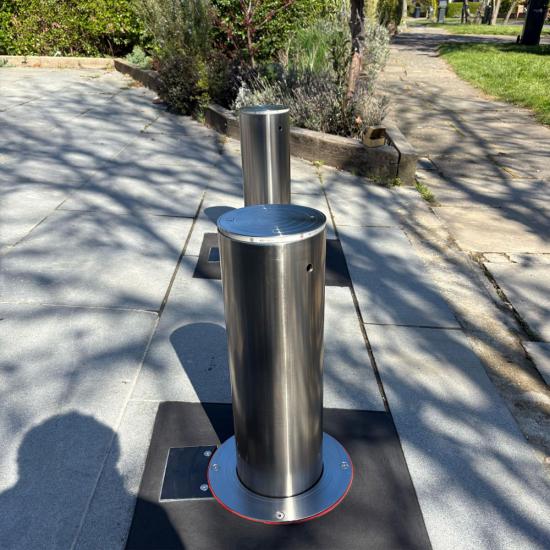
Fuel depots and chemical storage areas demand the highest crash ratings. These are the places where a vehicle intrusion could trigger a fire, explosion, or toxic release. IWA 14-1 or PAS 68 rated bollards, typically hydraulic and capable of stopping a 7,500 kg vehicle at 80 km/h, are the standard here. Many ports also add a secondary line of fixed bollards as a backup, so that if the automatic units are in the lowered position during an authorized vehicle passage, there is still physical protection for adjacent areas.
Administrative buildings, crew facilities, and passenger terminals handle people rather than cargo. The security requirement is lower, but the need to control vehicle access near pedestrians remains. A mix of fixed bollards along walkways and automatic bollards at vehicle entry points provides protection without making the area feel like a prison camp.
Marine-Grade Materials and Construction
Standard bollards that work fine on a city street will rust away in a port environment within a few years. The salt-laden air accelerates corrosion on carbon steel, and the constant moisture can penetrate electronic housings and cause short circuits.
This is why port bollards are almost always specified in 316L stainless steel, sometimes with an additional marine-grade powder coating for extra protection. The finish needs to withstand not just salt spray but also the occasional splash from dock operations, pressure washing, and contact with cargo handling equipment.
The foundation is equally important. Port surfaces are often reinforced concrete, but the ground can be unstable near waterfronts. Deep foundation installation with proper drainage is essential to prevent water pooling around the bollard casing, which would accelerate corrosion from the inside out. Experienced installers know to specify a minimum foundation depth that accounts for both the impact load requirements and the local water table.
Balancing Security with Port Operations
Ports are commercial operations first and security zones second. Any security measure that slows down truck turnaround times or interferes with cargo handling will face resistance from terminal operators who are measured on throughput and efficiency. The key is to make bollard systems as frictionless as possible.
The most effective approach is full automation. Bollards that integrate with the port's existing terminal operating system can read truck booking numbers, verify credentials in real time, and lower automatically for authorized vehicles. The driver does not need to stop, roll down the window, or interact with anyone. The process takes seconds.
For high-security zones where automated access is not appropriate, such as areas adjacent to naval vessels or military cargo, manual override and security guard verification remain standard. But even here, the trend is toward remote-controlled bollards that guards can operate from a nearby booth rather than having to physically lock and unlock barriers.
Port operators looking to upgrade their perimeter security should work with suppliers who understand both the security requirements and the operational realities of a working port. The right bollard solution stops threats without stopping the ships.
call us :
+86 18206096507 e-mail : [email protected]




 ipv6 network supported