The Threat Landscape at Military Installations
Military bases exist in a category of their own when it comes to physical security. Unlike commercial facilities, where the threat is often opportunistic or accidental, military installations face targeted attacks from adversaries who may have significant resources, detailed intelligence about the base layout, and a willingness to use extreme methods. Vehicle-borne attacks are one of the most dangerous scenarios because a single truck carrying explosives can breach a perimeter and cause catastrophic damage before security forces can respond.
The history of attacks on military facilities, from the 1996 Khobar Towers bombing to the 2019 Pensacola naval base shooting, shows that perimeter security is not a theoretical concern. These incidents have driven a fundamental shift in how military bases approach vehicle access control, moving from simple guard booths and chain-link fences to engineered hostile vehicle mitigation systems that can stop a determined attacker in a heavy vehicle.
Bollards are a central element of these systems. But not the kind you see outside a shopping mall. Military-grade bollards are designed, tested, and certified to specific crash performance standards that leave no room for ambiguity about what they can and cannot stop.
Understanding Crash Ratings for Military Use
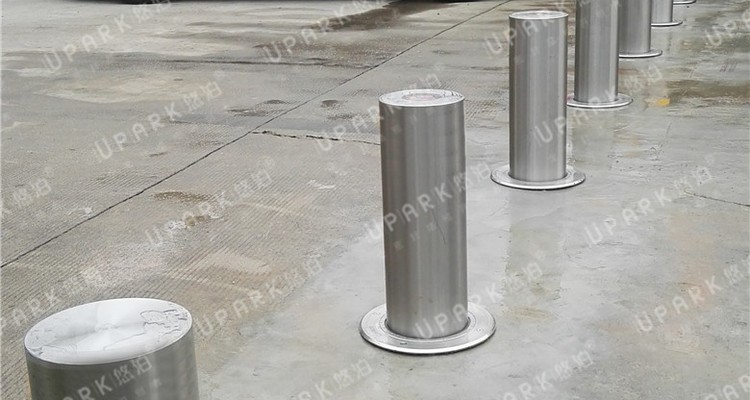
Crash ratings are not marketing claims. They are the results of controlled vehicle impact tests conducted by accredited laboratories. For military applications, the two most relevant standards are ASTM F2656 and IWA 14-1, both of which measure a bollard system's ability to stop a vehicle of a specific mass traveling at a specific speed.
The rating system uses two variables. The M rating defines the vehicle: M30 means a 6,800 kg truck at 48 km/h, M50 means a 15,000 kg truck at 80 km/h. The P rating defines the penetration distance: P1 means the vehicle is stopped within 1 meter of the bollard line, P2 allows up to 7 meters, and P3 up to 30 meters. For a military base, the gold standard is typically M50/P1, meaning the system will stop a 15-ton truck traveling at 80 km/h and not let it get more than one meter past the bollard line.
The K-rating system used by the U.S. Department of State (K4, K8, K12) is also still referenced in military procurement, though it is gradually being replaced by the ASTM M/P system. K12 is roughly equivalent to M50/P3, meaning it stops the same size vehicle but allows up to 30 meters of penetration. For most base entrance applications, K12 or M50 is the minimum acceptable rating, with P1 preferred for critical facilities like ammunition depots and command centers.
Layered Defense: How Bollards Fit into Base Security
No single security measure provides complete protection. Military base defense is built in layers, and bollards serve a specific role within that framework. The outermost layer is typically a standoff zone, a cleared area around the base perimeter designed to give security forces time to observe, assess, and engage a threat before it reaches anything valuable. Bollards are usually installed at the hard perimeter line, often in conjunction with fence gates that provide a secondary delay barrier. The bollards handle the vehicle threat, while the fence handles the pedestrian threat.
At vehicle entry points, the arrangement typically includes a guard house, a vehicle inspection area, and a series of bollards that can be raised to block the road if a vehicle is deemed threatening. The most sophisticated installations use pop-up bollards that can be activated in under two seconds, giving guards the ability to stop a vehicle that has passed the initial checkpoint but then behaves suspiciously.
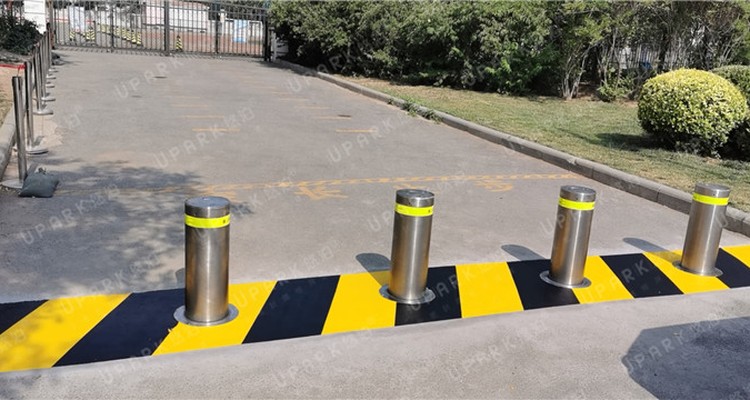
Inside the base, bollards protect individual high-value targets: armories, intelligence buildings, fuel storage, command posts, and barracks. These internal bollards are often fixed rather than automatic, since the access patterns within the base are more controlled and the goal is permanent protection rather than flexible access.
The combination of automatic rising bollards at entry points, fixed bollards around sensitive buildings, and integrated fencing creates a defense-in-depth approach that has become standard practice at military installations worldwide.
Procurement and Testing Considerations
Military procurement is rigorous. Bollard systems destined for base installations are typically required to have been physically crash tested by an accredited laboratory, with the test report available for review. Photographs of the test setup, high-speed video of the impact, and detailed measurements of penetration distance are all part of the documentation package.
Beyond the crash rating itself, military buyers look at factors like operational reliability in extreme conditions, electromagnetic interference compatibility with base communications systems, and the ability to integrate with existing access control infrastructure. Hydraulic bollards are often preferred for their higher crash ratings, but electromechanical units are gaining ground where the required threat level is lower and maintenance simplicity is valued.
For bases in coastal or desert environments, material selection is critical. 316 stainless steel with marine-grade coatings is standard for coastal installations. In desert environments, sand and dust protection for the bollard mechanism becomes a priority. Whatever the environment, the system needs to work the first time and every time, because there is no margin for failure in military perimeter defense.
call us :
+86 18206096507 e-mail : [email protected]




 ipv6 network supported