Railway platform safety barriers have become a standard requirement for new stations and a growing priority for existing ones. The technology landscape has evolved significantly, with multiple options now available beyond the traditional full-height platform screen doors (PSDs). This guide covers the standards, technologies, and cost considerations that railway operators need to evaluate when planning platform safety upgrades.
The regulatory framework has recently been strengthened. ISO 18298:2025, published in November 2025, is the first international standard specifically addressing platform barrier systems. It specifies requirements for the design, construction and operation of barriers positioned at the edge of station platforms, covering infrastructure owners, designers, installers and operators. In Europe, EN 17168:2020 sets similar requirements. For operators in China, the national standard GB24543-2009 covers safety rope requirements relevant to cable-based barrier systems. The 2026 revision of China’s railway design specifications introduces the concept of "flexible interception guidance," shifting the approach from passive warning to active physical管控.
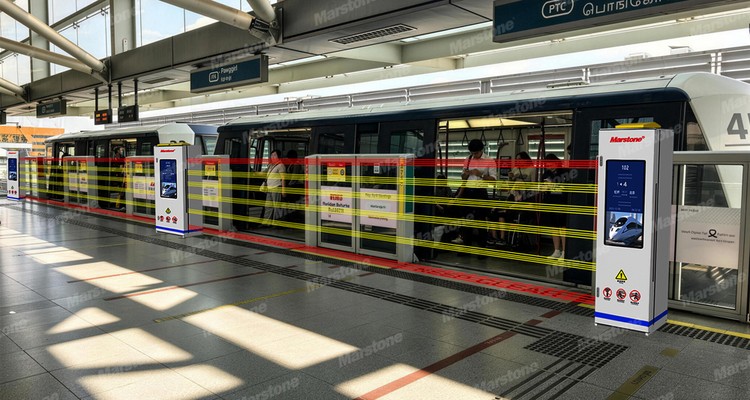
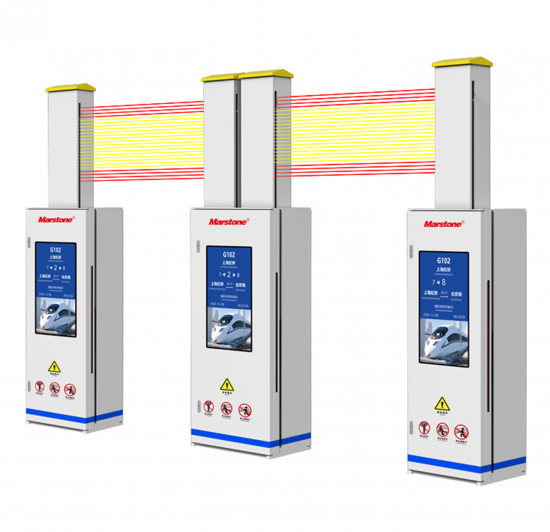
Retractable cable barriers occupy a growing share of the market. These systems use multiple high-tensile cables spanning between telescoping posts, rising and falling in response to train movements. Six cables of 5mm 304 stainless steel, plastic-coated and covered with foam protection tubes, provide a breaking strength exceeding 15,000N per cable and a design life of 1 million cycles or 30 years. The operating temperature range of -40°C to +65°C covers the vast majority of global railway environments. Control is managed through a five-level hierarchy from system-wide automatic to individual manual override.
Full-height PSDs remain the gold standard for completely enclosed platforms, particularly in underground metro systems where climate control and noise isolation are priorities. But they come with constraints. PSDs require train stopping accuracy within ±5 centimeters, track alignment sensors, and platform slabs of sufficient thickness to support the glass panel weight. Installation can take months and requires the station to be partially closed. For above-ground stations, existing platform retrofits, and lines with mixed train types, these requirements often make PSDs impractical.
Half-height platform edge doors offer a middle ground. They provide fall prevention without full enclosure, cost less than full-height PSDs, and allow natural ventilation. However, they still require door-to-door alignment and cannot accommodate trains with varying door positions. The stopping precision requirement remains tight at ±5 to ±10 centimeters.
Cost comparison across the four main options reveals the range:
Full-height PSD: highest cost per meter, driven by structural reinforcement, precision sensors, and extended installation timelines. Typical cost premium of 2x to 3x over cable barriers.
Half-height PED: moderate cost, but still requires door alignment systems and platform modifications. Approximately 1.5x to 2x the cost of cable barriers.
Retractable cable barrier: 30-50 percent lower than full-height PSD. Installation in 1-2 weeks with minimal platform modification. No door alignment required. Spans up to 25 meters reduce the number of support posts.
Rope-type barrier (carbon rope): competitive with cable barriers on equipment cost, but customized box configurations for specific train types add engineering and fabrication expense.
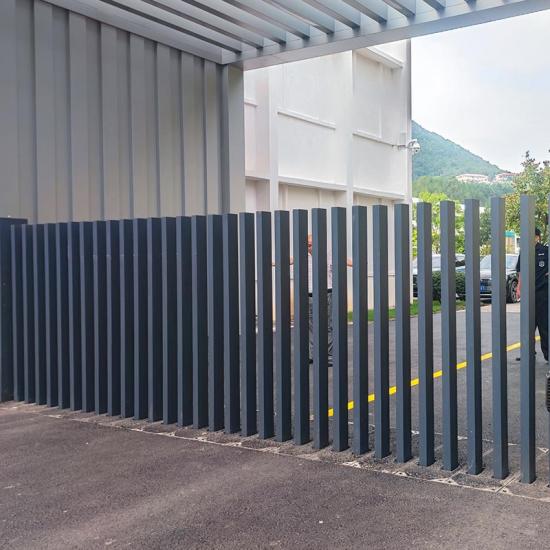
Lifting bar fence: similar cost range to cable barriers, with the advantage of no drainage requirement and simple floor-mounted installation.
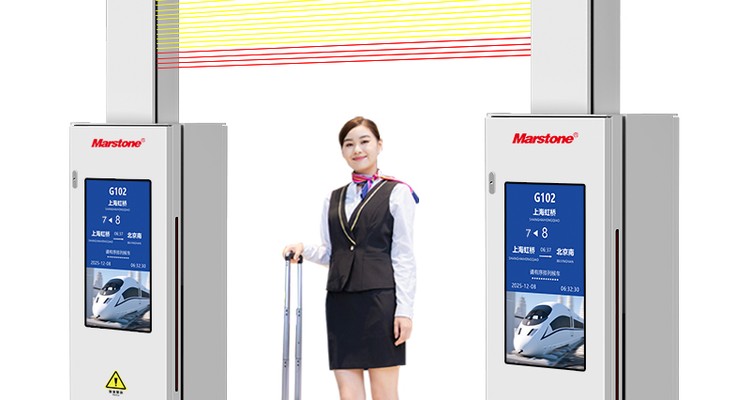
System reliability is supported by multiple layers of safety. Obstacle detection sensors stop barrier movement if an obstruction is detected, with three adjustable detection cycles before fault alarm. Audible and visual warnings activate during movement and when the barrier is in protective mode. In the event of power loss, the mechanism maintains its position without dropping. UPS backup ensures at least three complete operating cycles within 30 minutes of mains power failure. For emergency evacuation, quick-release mechanisms allow manual rope or cable decoupling.
The communication backbone for modern platform barriers is typically dual-redundant Ethernet with CAN bus backup, using Cat 6 cabling. Integration with station systems is achieved through Modbus TCP protocol and voltage-free dry contacts. The barrier system acts as a controlled object (actuator) rather than a control source, simplifying integration with existing ATO, signaling, and SCADA platforms. Each barrier unit includes a 32-inch, 1080p PIS display at 2000 nits brightness, eliminating the need for separate passenger information installations.
When selecting a platform safety barrier, operators should evaluate four factors. First, train stopping accuracy: if precision is better than ±10cm, half-height PEDs may be viable; if it is ±20cm to ±30cm or worse, retractable or rope-type barriers are more practical. Second, platform condition: existing concrete quality, thickness, and edge profile determine whether reinforcement is needed. Third, train diversity: mixed train types with different door positions favor cable or rope barriers over fixed-door systems. Fourth, budget and timeline: if the project requires minimal disruption and rapid deployment, retractable cable barriers offer the fastest path to platform safety.
The global market for platform safety barriers continues to expand. With the automatic platform screen door market valued at $1.22 billion in 2025 and projected to reach $2.65 billion by 2033, the share of retractable and flexible barrier systems is growing as operators seek cost-effective alternatives to traditional PSDs. For more on specific barrier technologies, see our platform barrier comparison series and perimeter security solutions.
call us :
+86 18206096507 e-mail : [email protected]




 ipv6 network supported