Bollard spec sheets list a lot of numbers. Diameter, height, wall thickness, voltage, power, rising speed, duty cycle, IP rating, impact energy. Some of these matter a lot for your project. Some are marketing numbers that look impressive but rarely affect day-to-day operation. Knowing which is which helps you compare products accurately and avoid overpaying for specs you do not need.
Rising and lowering speed is usually listed in seconds. A typical range for commercial bollards is 3 to 6 seconds up and 2 to 4 seconds down. UPARK electromechanical bollards rise in 5 seconds and lower in 3 seconds. For most access control situations, this is fast enough. A car approaching a gated entrance will wait 5 seconds without complaint. Emergency vehicle access might justify faster speeds, but anything under 3 seconds usually requires pneumatic or specialized high-speed hydraulic systems.
Duty cycle describes how many times the bollard can operate in a given period before it needs to rest. This matters for high-traffic sites like parking garages, logistics centers, and toll plazas. A duty cycle of 30 percent means the bollard can run for 3 minutes out of every 10. For a bollard that takes 8 seconds per full cycle, that is about 22 operations in 3 minutes. Electromechanical bollards generally have higher duty cycles than hydraulic ones because there is no fluid heat buildup. A motor can run continuously within its rated load; a hydraulic pump heats up the oil with each cycle.
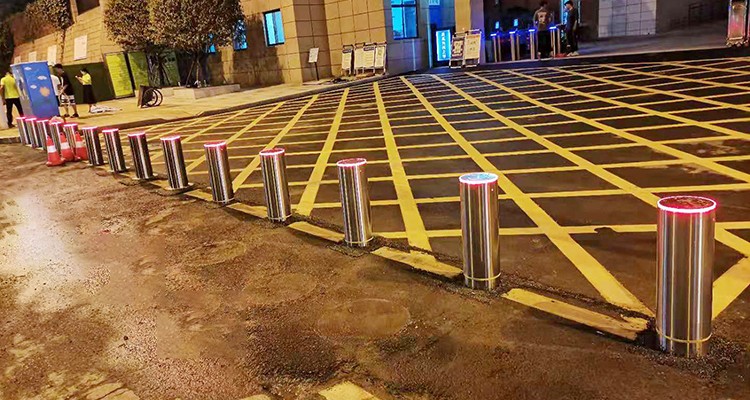
IP rating is the protection level against dust and water ingress. This one genuinely matters for inground bollards because they sit in a pit where water and debris collect. IP67 means the unit is dust-tight and can withstand temporary immersion in water up to 1 meter deep for 30 minutes. IP68 goes further, allowing for longer submersion. UPARK automatic bollards are rated IP67, which handles rain, flooding, and groundwater seepage without issues. Some competitors rate their products at IP65 or lower. The difference shows up in real life when a storm floods the bollard pit or when groundwater rises after heavy rain. An IP65 bollard is protected against jets of water but not against being submerged.
Voltage and power consumption affect installation cost more than performance. Traditional hydraulic systems often run on 220V or 380V AC, which requires a licensed electrician, proper grounding, and conduit rated for mains voltage. UPARK electromechanical bollards run on DC 36V, which is classified as extra-low voltage in most electrical codes. Any competent electrician can handle the wiring, and the safety requirements are minimal. Power draw is 400W per bollard, compared to 1.5 to 3 kW for a hydraulic pump unit.
Impact energy, measured in kilojoules, tells you how much kinetic energy the bollard can absorb during a collision. 579 kJ, the rating on the UPARK standard bollard, is a serious number. It corresponds roughly to a 7,500 kg truck at 50 km/h. For context, a typical passenger car at 50 km/h generates about 100 kJ. A large SUV at the same speed generates about 200 kJ. So 579 kJ covers most realistic vehicle threats short of a fully loaded heavy truck at highway speed.
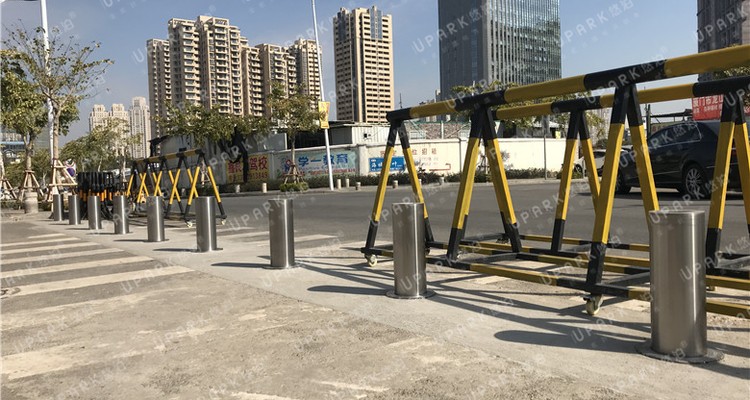
Diameter and height are straightforward but worth checking against your site requirements. A 219mm diameter post is standard for security applications and provides a visible physical barrier. The 600mm above-ground height is high enough to deter casual vehicle entry but low enough not to block pedestrian sightlines. For decorative or low-traffic applications, a 114mm diameter post works but provides less physical protection.
Wall thickness is where budget products cut corners. A 6mm wall on a 219mm post, which is UPARK standard, provides substantial impact resistance. Some cheaper options use 3mm or 4mm walls. The difference shows up on impact. A thin-walled post may stop a slow vehicle but will deform permanently, while a thick-walled post absorbs the energy and stays functional.
When comparing spec sheets, focus on IP rating, impact energy with the applicable test standard, and voltage requirements. These three tell you whether the bollard will survive its environment, stop the vehicles you are worried about, and fit within your electrical infrastructure. Rising speed, duty cycle, and power consumption are secondary considerations that matter for specific use cases but do not vary dramatically between competing products at the same quality level.
If you need help matching specifications to your project requirements, UPARK provides specification sheets and project consultation for all its bollard product lines.
call us :
+86 18206096507 e-mail : [email protected]




 ipv6 network supported