A crash-rated bollard is one that has been physically tested by driving a vehicle into it at speed and measuring the result. The rating tells you what kind of vehicle it stops, how fast that vehicle was going, and how much the bollard itself deformed. Without a crash test certificate, any claim about impact resistance is just marketing.
The most widely recognized standards are PAS 68 (British), IWA 14-1 (international, based on the old PAS 68 framework), ASTM F2656 (American), and GA/T 1343 (Chinese). They all measure the same basic thing but use different test parameters and classification systems.
PAS 68 originated in the UK and remains the benchmark in Europe, the Middle East, and much of Africa and Asia. The standard specifies a test vehicle weight, impact speed, and angle. A typical PAS 68 test uses a 7,500 kg truck at 48 km/h or 80 km/h, hitting the bollard head-on. The bollard passes if it stops the vehicle within a defined distance and the penetration of the vehicle body past the bollard line does not exceed one meter.
IWA 14-1 took the PAS 68 methodology and published it through the International Workshop Agreement process, making it more accessible globally. In practice, a bollard certified to IWA 14-1 at a given energy rating has undergone essentially the same test as the equivalent PAS 68 rating. UPARK automatic bollards are tested to IWA 14-1 with an impact energy rating of 579 kJ. To put that in context, 579 kJ is roughly equivalent to a 7,500 kg vehicle traveling at around 50 km/h.
ASTM F2656 is the American standard and uses a different classification system. It rates bollards by penetration distance using three levels: P1 (vehicle stops within 1 meter), P2 (stops within 3 meters), and P3 (stops within 7 meters). Each level can be tested at different vehicle weights and speeds. For high-security applications, P1 is the standard.
GA/T 1343 is the Chinese national standard for anti-ramming bollards. It has become increasingly relevant because many bollard manufacturers are based in China and test locally before pursuing international certification. The test methodology is similar but uses metric designations and has its own classification tiers.

Choosing the right level starts with a threat assessment. What kind of vehicle do you need to stop? A passenger car at 30 km/h is very different from a 15-ton truck at 80 km/h. For most commercial properties, retail stores, and office buildings, the realistic threat is a car or small van. A bollard rated at 300 to 500 kJ handles that scenario. For government buildings, embassies, and critical infrastructure, you want the 7,500 kg truck rating, which means 579 kJ or higher.
It is worth noting that crash rating applies to the complete installation, not just the bollard itself. The foundation has to match. A crash-rated bollard set in an inadequate foundation will tear out of the ground on impact. Manufacturers provide foundation specifications for each rating level, and following those specs is not optional.
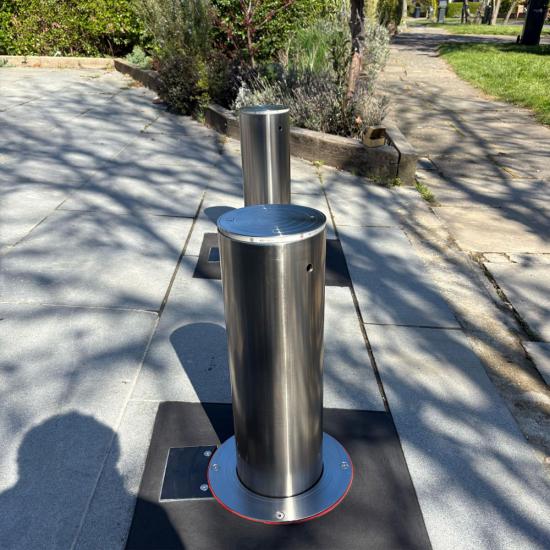
UPARK offers crash-rated configurations across multiple certification standards. The standard electromechanical bollard achieves IWA 14-1 certification at 579 kJ with the correct foundation design. For projects that specifically require PAS 68 or ASTM certification, UPARK works with accredited test laboratories to provide the required documentation. The UPARK automatic bollard line also pairs well with fixed bollards to create continuous crash-rated perimeters where automatic access is needed at gates while the rest of the line stays permanently protected.
One common mistake is over-specifying. A retail parking lot does not need embassy-grade protection, and paying for it adds cost with no practical benefit. Start with the realistic vehicle threat, match the standard and energy rating, verify the foundation design, and make sure the test certificate covers the exact configuration you are buying.
call us :
+86 18206096507 e-mail : [email protected]




 ipv6 network supported