If you own or manage commercial property, here is a statistic that should keep you up at night: 40 percent of all property crime in the United States happens in parking lots. Not dark alleys, not residential streets — parking lots.
The numbers have gotten worse every year since 2019. FBI data shows parking lot crime has risen 18 percent nationally since then. The National Insurance Crime Bureau estimates annual parking lot vehicle theft losses at $3.2 billion. That is just the thefts — add vandalism, break-ins, and personal injury claims, and the total cost to property owners runs much higher.
The scope of the problem
The FBI recorded roughly 318,000 vehicle thefts in 2022. About one in four of those — roughly 79,500 cars — were taken from a parking lot. When you widen the lens to all property crime, the numbers are staggering. The Bureau of Justice Statistics found that 40 percent of all property crime in the US occurs in parking facilities.
Some states hit harder than others. In California, 40 percent of the state's 89,000 vehicle thefts in 2023 happened in commercial parking lots. In Florida, it was 35 percent of 45,000. Nevada leads the nation with 45 percent of thefts occurring in casino parking structures. In Illinois, 28 percent of 32,000 thefts were traced to public parking areas.
The pattern holds city by city. Los Angeles recorded 12,500 parking lot vehicle thefts in 2023 — 40 percent of all car theft in the city. Chicago saw 8,200 parking lot thefts in 2022, up 15 percent year over year. New York City logged 5,600, up 10 percent. Philadelphia hit 4,100, up 12 percent. Portland, Seattle, Atlanta — all reporting double-digit increases.
Why parking lots are ideal crime scenes
Parking lots have a structural problem that makes them attractive to thieves. They are accessible, they are anonymous, and after hours they are empty.
Think about the design. Most commercial parking lots have multiple entry and exit points, minimal physical barriers, and long stretches with no natural surveillance. Lighting is often patchy. Security patrols, if they exist, follow predictable schedules. A thief who knows the rhythm can time a theft with near certainty.
The time pattern is the most telling data point. Three-quarters of all parking lot crime happens at night, according to Crime Prevention Through Environmental Design research. The National Crime Victimization Survey puts it at 65 percent. Either way, the message is the same: darkness enables crime.
The location breakdown is equally instructive. Shopping centers and malls account for 28 percent of parking lot crime hotspots. Apartment complexes are 22 percent. Retail parking lots alone see 45 percent of all vehicle break-ins nationwide. Multi-level parking garages carry four times the crime risk of surface lots, according to the Urban Institute. Airport parking has the highest per-vehicle theft rate of any parking category.
The layered security model
Security professionals talk about deterrence, detection, and delay. Most commercial parking lots do fine on detection — cameras are cheap and everywhere. Where they fail is deterrence and delay.
A camera records a theft. It does not stop one. If a thief can drive into a lot at 2 a.m., pull up next to a targeted vehicle, spend two minutes on a CAN-bus injection or a relay attack, and drive out the exit, the camera captures a crime that is already over. The vehicle is gone, and the license plate leads to a stolen car or a fake tag.
The fix is not more cameras. It is layers.
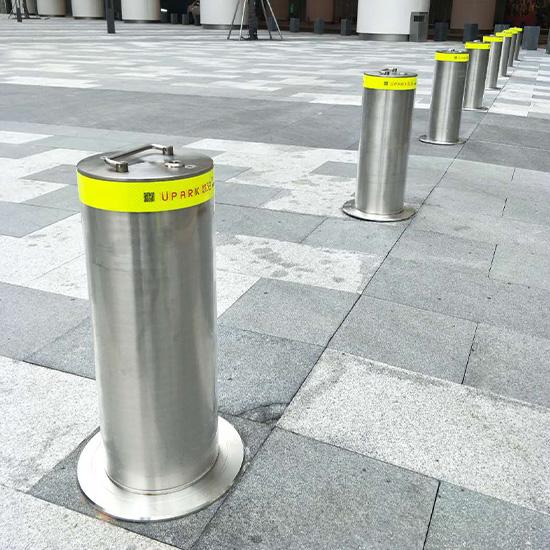
Layer one is physical access control at the perimeter. Automated bollards, rising arm barriers, and retractable posts create a hard stop between a vehicle and a parking area. A thief cannot CAN-bus inject a car he cannot reach. If the perimeter is gated with crash-rated bollards, he moves on to an unprotected lot.
Layer two is lighting and sight lines. The 2026 research is clear: well-lit lots with no visual blind spots see measurably fewer incidents. Crime Prevention Through Environmental Design principles recommend eliminating hiding spots, trimming landscaping, and ensuring every parking space is visible from at least two angles.
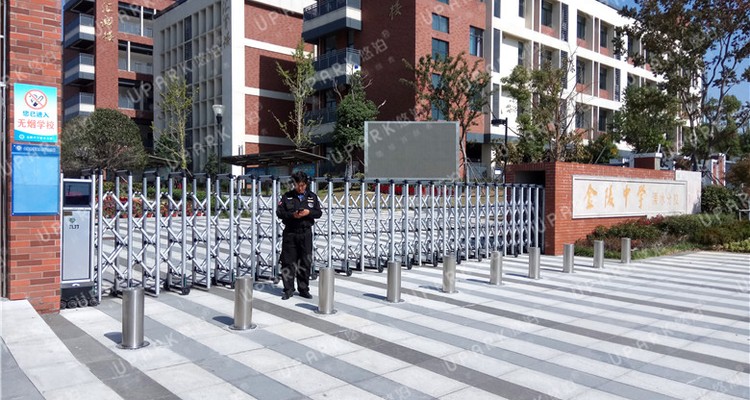
Layer three is human presence. Security patrols, even randomized, raise the perceived risk for a thief. If the lot is gated and requires credential access, the barrier to entry is higher still.
Layer four is technology — the cameras, the license plate readers, the AI analytics. These tools matter, but they work best when the physical layers are already in place. A camera alone is a witness. A camera behind a bollard is part of a system.
What this means for commercial property owners
The Insurance Institute reports that basic security measures can prevent up to 70 percent of parking lot crime. A RAND study found surveillance cameras alone reduce parking lot crime by 37 percent. But the biggest impact comes from combining physical barriers with electronic monitoring.
For a shopping center with 200 parking spaces, the math is simple. Each vehicle theft costs the property owner in liability exposure, reputation damage, and tenant attrition. If one theft happens per month, and each incident costs $50,000 in direct and indirect losses, the annual exposure is $600,000. A single automated bollard installation at the lot entrance costs a fraction of that and lasts 15 years.
For fleet yards and dealership lots, the stakes are even higher. The IAATI 2026 white paper on auto theft trends calls out organized crews using drones and thermal cameras to case dealer lots before nighttime raids. A perimeter of crash-rated bollards turns a soft target into a hard one. Most crews do not carry industrial cutting equipment — they carry laptops and key programmers. The bollard stops them cold.
Summary
Parking lots are not incidental to vehicle theft — they are the primary venue. One in four stolen cars comes from a parking lot. Three-quarters of the crime happens at night. And property owners are paying for it in insurance premiums, liability claims, and lost tenants.
The answer is not one thing. It is the layered model: perimeter barriers that prevent access, lighting and sight lines that eliminate hiding spots, patrols that create unpredictability, and cameras that capture what the barriers miss.
A thief can defeat a camera by wearing a mask. He cannot defeat a steel bollard rated to stop a five-ton vehicle. The bollard does not need software updates. It does not care what time it is. It just stands there, and that changes the math for everyone.
call us :
+86 18206096507 e-mail : [email protected]




 ipv6 network supported