Platform safety is not a one-size-fits-all problem. Different railway systems around the world have developed their own answers to the same fundamental challenge: how to prevent passengers from falling onto the tracks while keeping platforms accessible for trains with varying door positions and stopping accuracy. Two approaches that have emerged in Asia illustrate the range of solutions available.
Japan faced the challenge first. JR West, the railway operator serving the Kansai region around Osaka and Kyoto, operates trains with different door configurations on the same platforms. A single platform might see 3-door trains and 4-door trains stopping at different positions. Traditional sliding platform screen doors, with their fixed opening widths of around 3 meters, simply could not accommodate this variability.
JR West’s solution, developed in partnership with Nippon Signal and JR West Techsia, was the retractable rope-type platform fence, first tested in 2013 and deployed commercially at Takatsuki Station in March 2016. The system uses five horizontal ropes that descend from telescoping posts to form a barrier when a train is not at the platform. When a train arrives and stops, the posts rise and the ropes retract into a slim housing, clearing the full width of the platform edge for passenger boarding.
The key innovation was the rope material. Early installations used stainless steel wire rope, which required high tension to prevent sagging. This put significant load on the housing and platform structure and limited the maximum opening width. In 2017, JR West switched to carbon strand rods at Rokkomichi Station. Carbon rods are lightweight, high-strength, and resistant to sagging, allowing opening widths up to 13 meters with a housing depth of only 250 millimeters. The stop tolerance is an impressive ±1,000 millimeters, meaning the system works even when trains stop a full meter off from their target position.
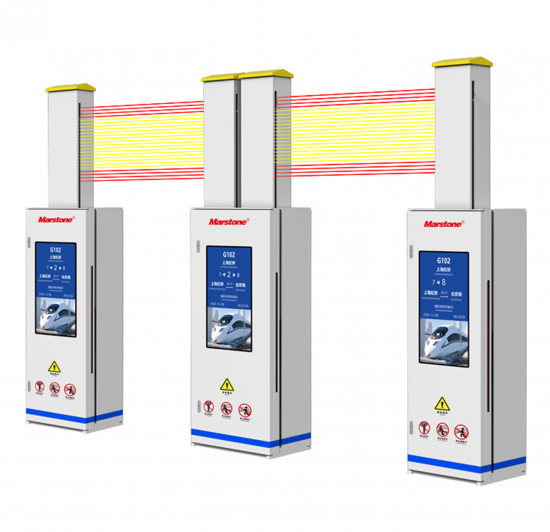
China’s approach, through UPARK’s retractable cable barrier, shares the same core concept but takes a different engineering path. Instead of horizontal ropes on a single housing, the UPARK system uses six 304 stainless steel cables running vertically between floor-mounted telescoping posts, with each cable rated at over 10 kilonewtons of tension. The cables are plastic-coated for weather resistance and covered with 6-centimeter foam tubes that prevent scratching and improve visibility. Nylon rope is available as an alternative for stations that prefer a lighter, more elastic option.
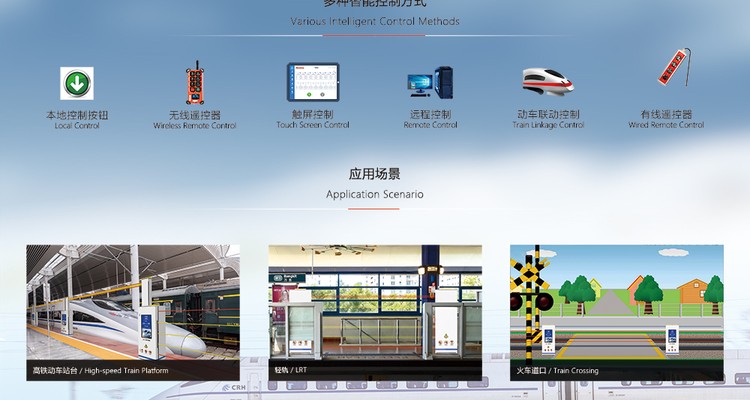
The most notable difference is span. UPARK’s system reaches 25 meters between posts, nearly double the JR West opening width. This means fewer posts per platform, which reduces installation complexity and cost. The stop tolerance of ±300 millimeters is narrower than the Japanese system, but still sufficient for most high-speed rail and metro operations where trains stop with greater consistency. The housing depth of 480 millimeters is larger than the Japanese 250-millimeter unit, reflecting the more robust drive mechanism and the inclusion of a 32-inch PIS display in each cabinet.
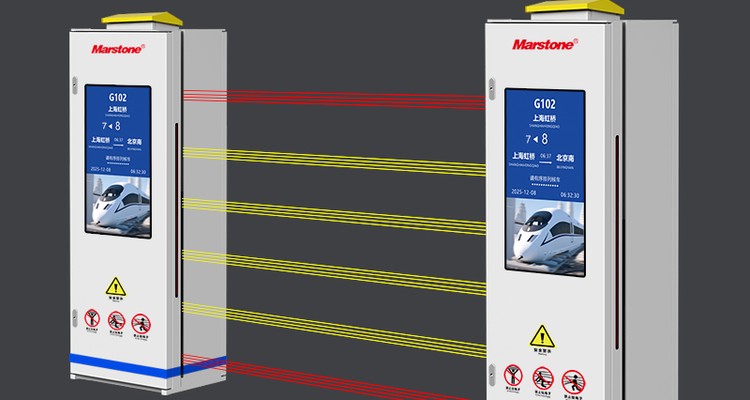
The control philosophies also differ. JR West’s system uses ground-based sensors to detect train position and length, with no need for train-to-ground communication. Opening is automatic; closing is triggered manually by the train conductor. UPARK’s system uses a five-level control hierarchy from system-wide automatic control down to individual manual override, with Modbus TCP communication and integration with existing ATO and SCADA platforms. The UPARK system is designed as a fully automated, signal-integrated solution from the ground up.
Cost and deployment scale tell another part of the story. As of 2023, the Japanese system was installed at 9 stations covering 17 platforms. The high cost of customizing each installation for the specific train types serving that platform has limited wider deployment. By contrast, UPARK’s system has been deployed across more than 70 cities in China, benefiting from more standardized platform configurations and a design that accommodates a wider range of installation conditions with minimal customization.
Both approaches share a common insight: when traditional sliding PSDs cannot work, retractable barriers offer a path to platform safety that fixed structures cannot provide. The Japanese system excels in tight spaces with its ultra-slim 250mm profile and extreme stop tolerance. The Chinese system offers wider spans, lower cost per meter, and greater flexibility for retrofit projects. For railway operators evaluating platform safety upgrades, the choice between these approaches depends on platform geometry, train variability, budget, and the level of integration with existing signaling infrastructure.
The global trend toward retractable platform barriers is clear. With ISO 18298:2025 now established as an international standard for platform barrier systems, more operators worldwide are looking beyond traditional PSDs. The technology continues to evolve: carbon composite ropes, smarter sensor integration, and predictive maintenance are all on the horizon. For more on how these systems compare with full PSD alternatives, see our retrofit platform safety guide and related perimeter security products.
call us :
+86 18206096507 e-mail : [email protected]




 ipv6 network supported