Not every railway station was built with platform screen doors in mind. Many existing stations across Asia, Europe, and the Middle East were designed decades ago, with platform geometries, concrete specifications, and train stopping systems that cannot easily accommodate full-height PSDs. Retrofitting these stations with glass screen doors often requires tearing up the platform edge, reinforcing the slab, installing precision alignment sensors, and taking the station out of service for weeks or months. For operators looking to upgrade safety without that level of disruption, retractable cable barriers have emerged as a practical alternative.
The core problem is that full-height PSDs demand precise train stopping—within ±5 centimeters of a fixed door position. If a train overshoots or falls short by even a small margin, the platform doors and train doors do not align, and passengers cannot board safely. Modern metro systems are designed around this constraint. But older railway stations, along with many light rail and commuter rail platforms, were built for a different era. Trains of varying lengths and door configurations share the same tracks. Stopping accuracy is often ±20 to ±30 centimeters. Retrofitting such stations for ±5 cm precision would require new signaling systems, track modifications, and sometimes rolling stock upgrades. The cost and operational impact are prohibitive.
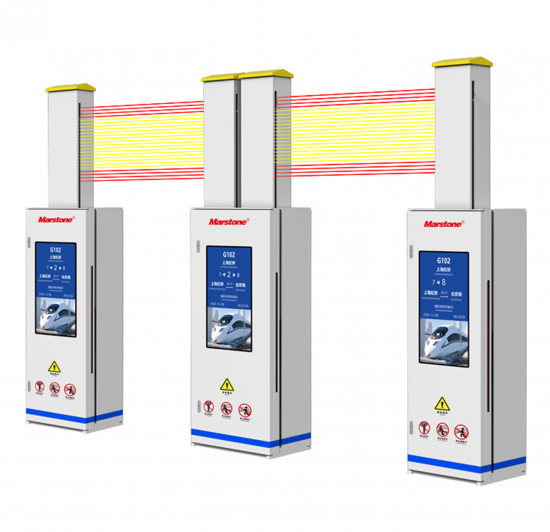
Retractable cable barriers bypass this problem entirely. Because they do not rely on door-to-door alignment, they work with any stopping accuracy. A barrier unit consists of six stainless steel cables spanning between telescoping posts, rising from a retracted height of about 1.5 meters to a full barrier over 2 meters tall when protection is needed. The cables are 5mm 304 stainless steel, plastic-coated for weather resistance, and covered with high-density foam tubes that prevent scratching and improve visibility. Each cable is rated at over 10 kilonewtons of tension, which means the barrier can absorb significant impact without failing.
The installation requirements are where cable barriers really differentiate themselves from PSDs for retrofit projects. A typical PSD retrofit requires a platform edge slab of at least 200mm thickness, often more, with specific reinforcement patterns to support the weight and dynamic loads of glass panels. Cable barriers require a C30 concrete edge, just 150mm thick, which matches the specifications of most existing HSR and commuter rail platforms. In some cases, the base plates can be installed directly on the existing platform surface using expansion bolts, with no concrete work at all. The barrier units set back 1.2 meters from the platform edge, a dimension that works for 16-car train consists without encroaching on the passenger circulation zone.
The retrofit process is straightforward. First, a site survey establishes the platform dimensions, concrete condition, and cable routing paths. Based on the survey, a system design determines the number of barrier units needed—each spanning up to 25 meters between posts—and the positioning of end units and intermediate units. Single-direction units are used at the ends of the barrier line, while bi-directional units handle the middle sections. Power and communication cables are run in surface-mounted conduits or embedded in shallow trenches. The entire installation typically takes one to two weeks, with most work done during off-peak hours or overnight to avoid disrupting station operations.
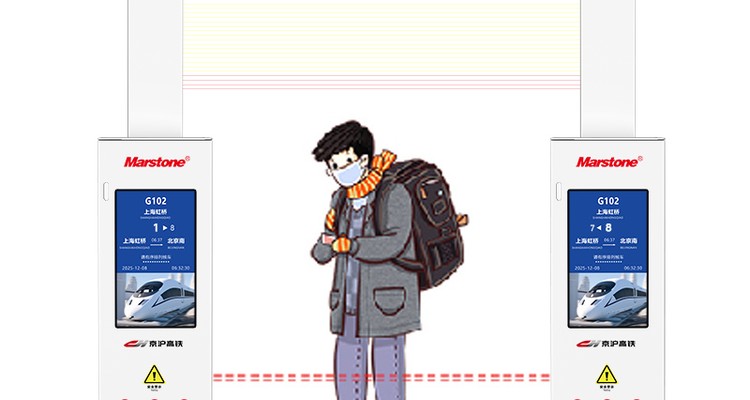
The control system integrates with the station’s existing signal infrastructure through standard protocols. Modbus TCP is preferred for new installations, while voltage-free dry contacts provide a fallback for older systems. The barrier can be configured as a controlled object—receiving signals from the station control system rather than generating them—which simplifies integration with existing ATO (Automatic Train Operation) and SCADA platforms. For stations that lack a centralized signal system, the barriers can operate independently on a timer or manual control basis, with the option to upgrade to full automation later.
Operators also gain the built-in passenger information system. Each barrier unit includes a 32-inch, 1080p display capable of showing train numbers, arrival times, carriage positions, and safety announcements at 2000 nits brightness, readable even in direct sunlight. This eliminates the need for separate display installations along the platform edge, which would be another cost and complexity factor in a PSD retrofit project.
The durability track record matters for retrofit decisions where the equipment is expected to remain in place for decades. The system has been tested at -40°C in northern Chinese stations without mechanical issues. The electromechanical drive requires no hydraulics or pneumatics, which means no fluid leaks, no drainage requirements, and simpler maintenance. The nylon rope variant, available for stations that prefer a lightweight, easily replaceable option, uses 3mm strands braided into 5-strand ropes with a breaking strength of 175 to 200 kilograms and natural elasticity that absorbs impact energy.
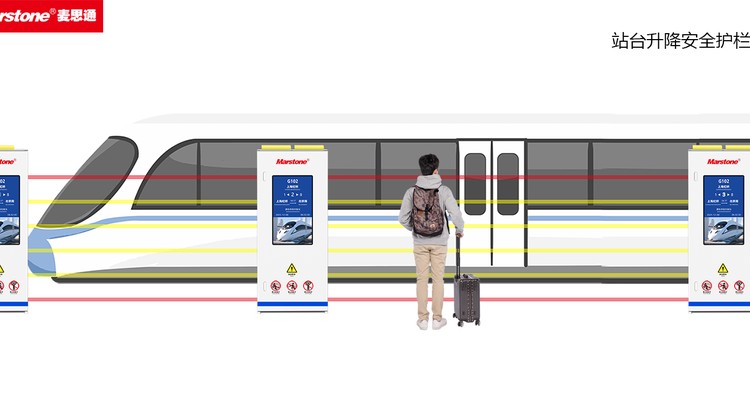
For railway operators evaluating platform safety upgrades on existing stations, the choice often comes down to budget, timeline, and operational disruption. Full PSD retrofits deliver complete enclosure and climate separation where the infrastructure supports them. But for the many stations where the platform geometry, train diversity, or stopping precision rules out PSD, retractable cable barriers offer a path to platform safety that works with the existing infrastructure rather than requiring its replacement. The retrofit results from recent projects suggest this approach is gaining traction across Asia and beyond.
call us :
+86 18206096507 e-mail : [email protected]




 ipv6 network supported