China’s high-speed rail network now stretches over 40,000 kilometers, connecting more than 1,000 stations across the country. With that scale comes a practical question: how do you secure every platform against falls and intrusions when no two stations are quite the same?
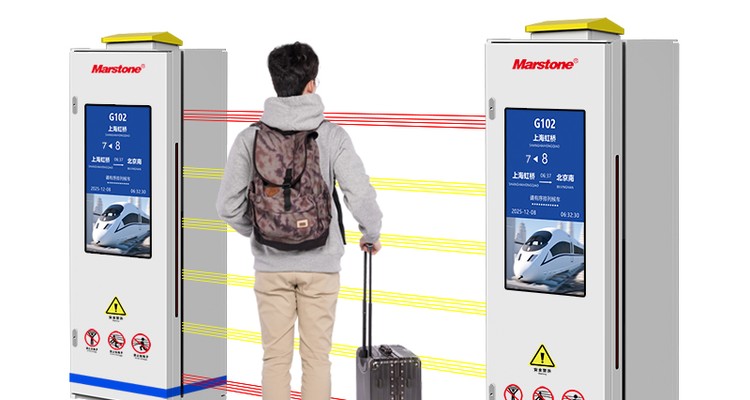
Full-height platform screen doors work well in metro systems where trains are identical, stopping positions are precise, and platforms are uniform. But China’s HSR stations handle multiple train models, varying platform heights, and passenger volumes that shift dramatically during holiday rushes. In many stations, glass screen doors are either too expensive to install across the full platform length or incompatible with the existing infrastructure. This is where retractable cable barriers have started to fill a specific gap.
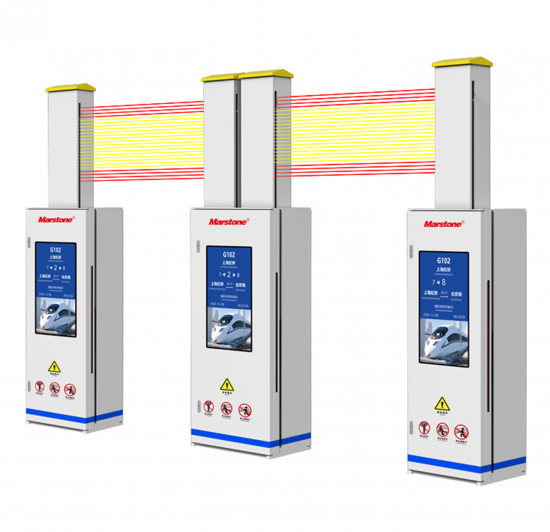
The principle is straightforward. Six stainless steel cables, each 5 millimeters in diameter, rise from a retracted height of 1.4 meters to a full barrier over 2 meters tall when a train is not at the platform. The entire mechanism is housed in a dual-section telescoping unit that can be configured as a single post or a double post depending on platform width. Each cable is tension-rated at over 10 kilonewtons, which means the barrier is strong enough to stop a person from falling or crossing onto the tracks. The system’s SIL2 safety certification matches the requirements of mainline rail operators.
Several Chinese railway stations have begun evaluating or deploying these systems, particularly in scenarios where retrofitting is involved. Older stations that were built before platform safety standards evolved face a common problem: the platform slab is too thin or the edge profile is wrong for PSD installation. Cable barriers require only a C30 concrete edge with a minimum thickness of 150 millimeters, a specification that matches most existing HSR platforms. The 5-to-8-second rise and fall time fits within typical station dwell windows without disrupting schedules.
Temperature tolerance matters for China’s geography. HSR stations in the northeast can see winter lows of -30°C, while summer highs in the south push past 40°C. The cable barrier is rated for operation from -30°C to 65°C, with the mechanism designed to hold its raised position even if power is lost. In heavy rain, snow, or dust, the system maintains the same 100,000-cycle durability target, meaning years of reliable operation without major servicing.
The control system offers five levels of operation that station managers can adapt to their workflow. At the highest level, a station-wide system manages all barriers simultaneously. Remote emergency controls let a central operations center raise or lower barriers across multiple platforms at once. At the platform level, station staff have their own control panel (PSL). Individual barrier sections can be addressed through unit-level controls. And for maintenance scenarios, the local control box (LCB) gives technicians direct manual override, bypassing all automated commands.
Each barrier section comes with a built-in 32-inch display running at 1080p resolution and 2000 nits brightness. These displays are visible even in direct sunlight and can show train numbers, arrival times, carriage positions, and safety announcements. The passenger information system is integrated directly into the barrier unit, so stations do not need separate display installations along the platform edge.
Looking ahead, the technology is moving in a few clear directions. One is smarter integration with station signaling systems. Instead of operating on a fixed schedule, next-generation barriers will read approaching train data in real time and adjust their timing based on the specific train type, speed, and platform assignment. Another direction is predictive maintenance: vibration sensors and cycle counters on each barrier unit will feed data back to a central system that flags worn components before they fail.
There is also growing interest in customizing barrier height and cable spacing for different station categories. A small regional station with lower train speeds may not need the same barrier height as a major hub where trains pass through at higher speeds. Modular designs that allow stations to add or remove cable sets depending on their specific risk assessment would give operators more flexibility than a one-size-fits-all approach.
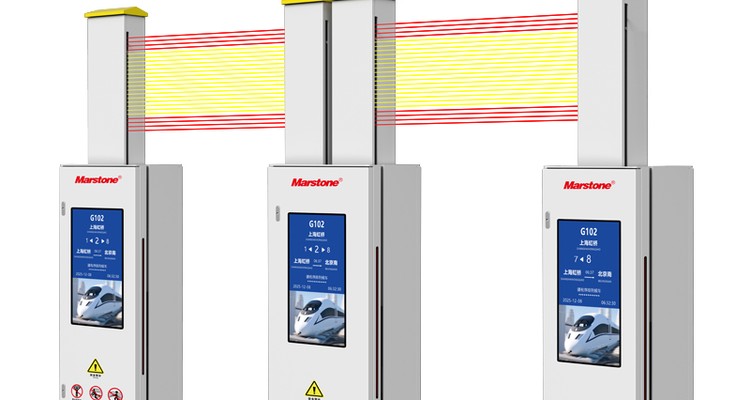
China’s railway expansion is not done yet. New lines continue to open in the western regions, and existing stations are being upgraded to handle increasing passenger numbers. For stations where full PSD installation is not practical—whether because of cost, platform geometry, or train variety—retractable cable barriers offer a proven alternative that works within the existing infrastructure. The next few years will likely see wider adoption as more station operators look beyond the PSD-only approach to platform safety.
For railway operators evaluating platform safety upgrades, it is worth looking at how different station types map to different barrier solutions. Cable barriers are not a replacement for PSDs in every scenario, but they solve a set of problems that glass screen doors simply cannot address. For more on how these systems compare, see our earlier article on retractable cable barriers versus platform screen doors. Related perimeter products like automatic fence gates may also be relevant for station perimeter security.
call us :
+86 18206096507 e-mail : [email protected]




 ipv6 network supported