Light rail transit (LRT) and tram networks occupy a unique position in urban mobility. Unlike fully grade-separated metro systems, light rail frequently operates at street level, shares corridors with road traffic, and serves passengers through frequent, closely spaced stops. This operational profile creates a distinct set of platform safety challenges that full-height platform screen doors (PSDs) were never designed to solve. The automatic platform guardrail has emerged as the pragmatic, cost-effective answer for light rail operators who need reliable edge protection without the structural burden of glass-wall systems.
The Structural Reality of LRT Stops
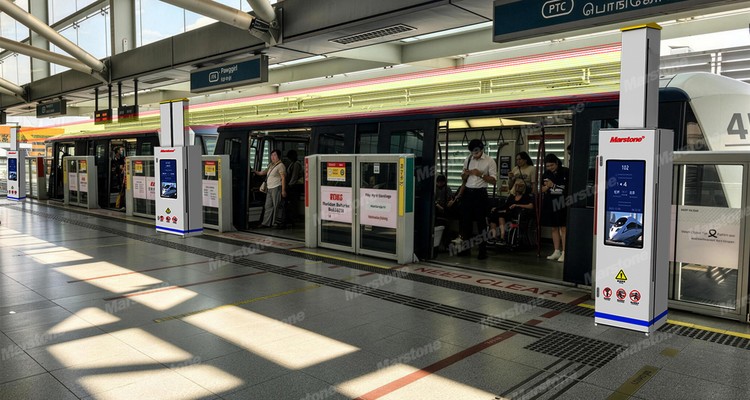
Most LRT and tram platforms are at-grade or low-embankment, with the platform edge exposed to an open track environment rather than a sealed tunnel. Passengers wait just meters from the rail, often with limited physical separation. Trains arrive every few minutes during peak service, and dwell times are short. In this environment, the safety barrier must cycle reliably dozens or hundreds of times per day, tolerate weather and vibration, and never obstruct boarding when a train is present. Static yellow lines and painted markings provide no active protection; they rely entirely on passenger discipline.
Mixed Rolling Stock Defeats Fixed-Door Systems
A defining characteristic of many light rail networks is fleets that mix vehicle types, lengths, and door configurations on the same platform. New articulated low-floor trams may share a stop with older high-floor units or with trains of different carriage counts. Full-height PSDs require precise alignment between the screen-door leaves and the train doors — a constraint that becomes unworkable when door positions vary train to train. The automatic platform guardrail lowers completely to the platform surface when a train docks, eliminating any door-alignment requirement. It protects the edge when no train is present and clears the way for boarding regardless of which rolling stock has arrived.
Why Full-Height PSDs Misfit Light Rail
Beyond door alignment, PSDs impose heavy civil-engineering costs that rarely pencil out for LRT. The platform edge must be structurally reinforced to carry full-height glass panels, a drainage and cable infrastructure must be installed, and station closures during construction can stretch into months. For a network of dozens or hundreds of light rail stops, the capital and disruption are prohibitive. The guardrail delivers comparable protection at 60 to 70 percent lower installed cost, with no structural reinforcement and no extended service interruptions.
The Electromechanical Advantage for Frequent-Cycle Service
The UPARK automatic platform guardrail uses an electromechanical drive on a 36V DC low-voltage architecture. There is no oil to thicken in the cold and no pneumatic line to freeze — both common failure modes for fluid-dependent barriers in outdoor LRT environments. The sealed drive runs from -40C to +70C without heating, and industrial-grade motors are validated for over 250,000 continuous operation cycles, supporting 10+ years of maintenance-free service even under high-frequency LRT duty cycles. Because each unit is self-contained, a single unit can be serviced or replaced without taking the whole platform edge offline.
Active Safety Where LRT Needs It Most
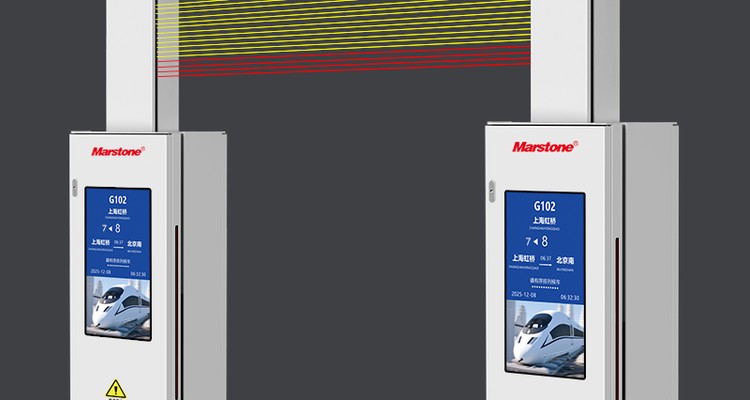
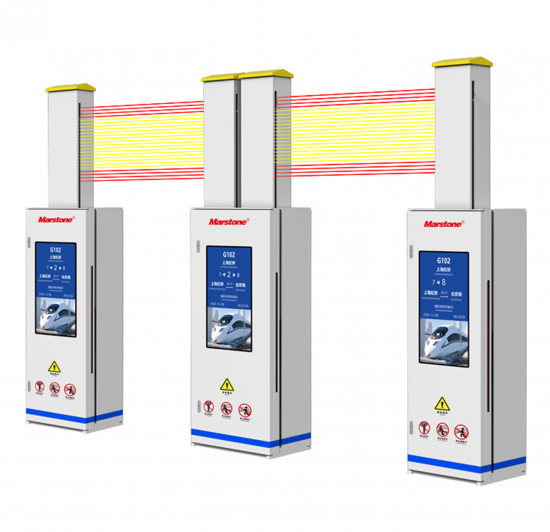
Passive separation is not enough at crowded street-level stops. The guardrail integrates active detection: infrared sensors monitor the safety line and trigger visual and audible alarms when passengers or objects approach the barrier. A three-color traffic light above the guardrail signals boarding status — red when raised, green when lowered — giving clear, language-independent guidance to commuters. Critically, the barrier carries EN 13231-3 certified impact resistance rated to 300 kg, so it remains intact if a passenger stumbles against it or luggage is pushed into it during busy boarding.
Choosing the Right Barrier Type
Light rail deployments typically select among three guardrail configurations: cable-type (retractable steel cable, minimal visual obstruction, ideal for heritage or scenic tram corridors), board-type (rigid panel, stronger visual and physical presence), and rope-type (lighter-duty). The choice depends on station aesthetics, desired visual barrier, and impact requirements. Our dedicated guide to rope vs board vs cable platform barriers walks through the selection logic for specific station conditions.
Signaling Integration and Phased Retrofitting
The guardrail control device interfaces with standard railway signaling. It receives train approach, arrival, and departure signals and coordinates barrier movement accordingly, so operation is fully automatic and consistent with existing station logic. Retrofitting existing LRT stops is straightforward: the electromechanical drive needs no drainage pit, and installation proceeds in sections during overnight maintenance windows, keeping stops in service. The Singapore LRT platform safety case study illustrates how cable-type barriers were deployed in a live urban transit environment.
Compliance and Lifecycle
Every system is tested to EN 13231-3 and operates on 36V low-voltage architecture, meeting international low-voltage safety requirements. Standby power consumption stays below 10 watts per unit, and optional solar integration supports remote or grid-constrained stops. With 60 to 70 percent lower capital cost than PSDs and minimal lifecycle maintenance, the guardrail is the defensible choice for light rail networks balancing safety, budget, and operational continuity.
To evaluate automatic platform guardrails for your light rail or tram network, visit the automatic platform guardrail product page or contact UPARK for a project consultation tailored to your rolling stock and station profile.
call us :
+86 18206096507 e-mail : [email protected]




 ipv6 network supported